
Artifact Highlight: Crew Member Art
Posted by James Burke on April 8, 2026
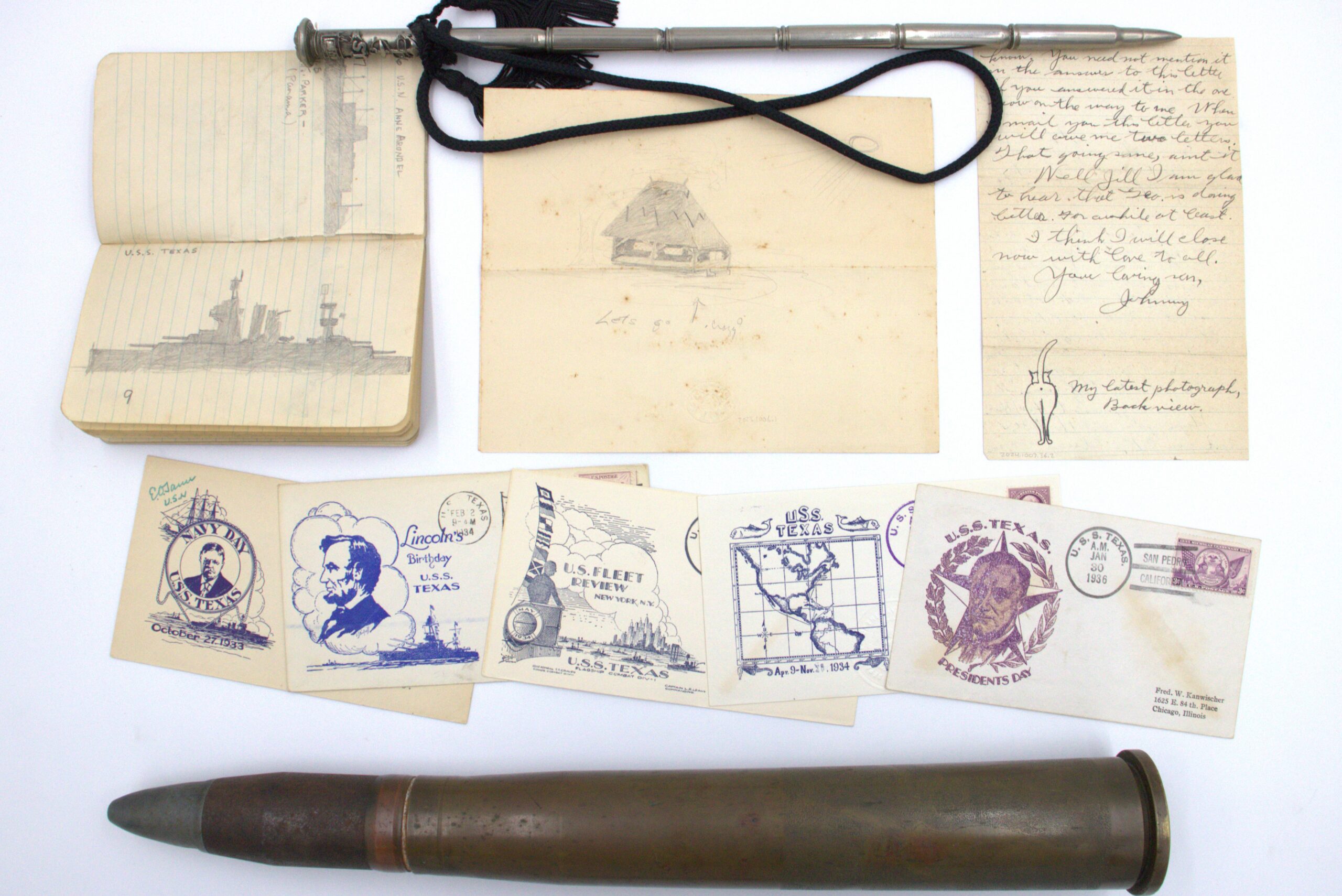
Across the service history of Battleship Texas, whether in a state of war or peace, underway or in port, members of her crew have created works of art from sketch to sculpture. The artists did not imagine their works in the halls of fine arts museums, but they made them nonetheless. Just as their fellow crew members spent their free time in sports, going ashore, or participated in various activities on the ship, so too did they create with what little material provided to them. While artwork is seldom within collection donations, those pieces within do demonstrate the trends of the period. Whether used as a recording device, adornment, or time killer, artists contributed much to life on Texas and throughout the US fleet. The dramatic modern oil paintings of battleships firing their main battery may strike the eye as a touch more exciting, but the works of crewmembers share a more intimate history of their time on board.
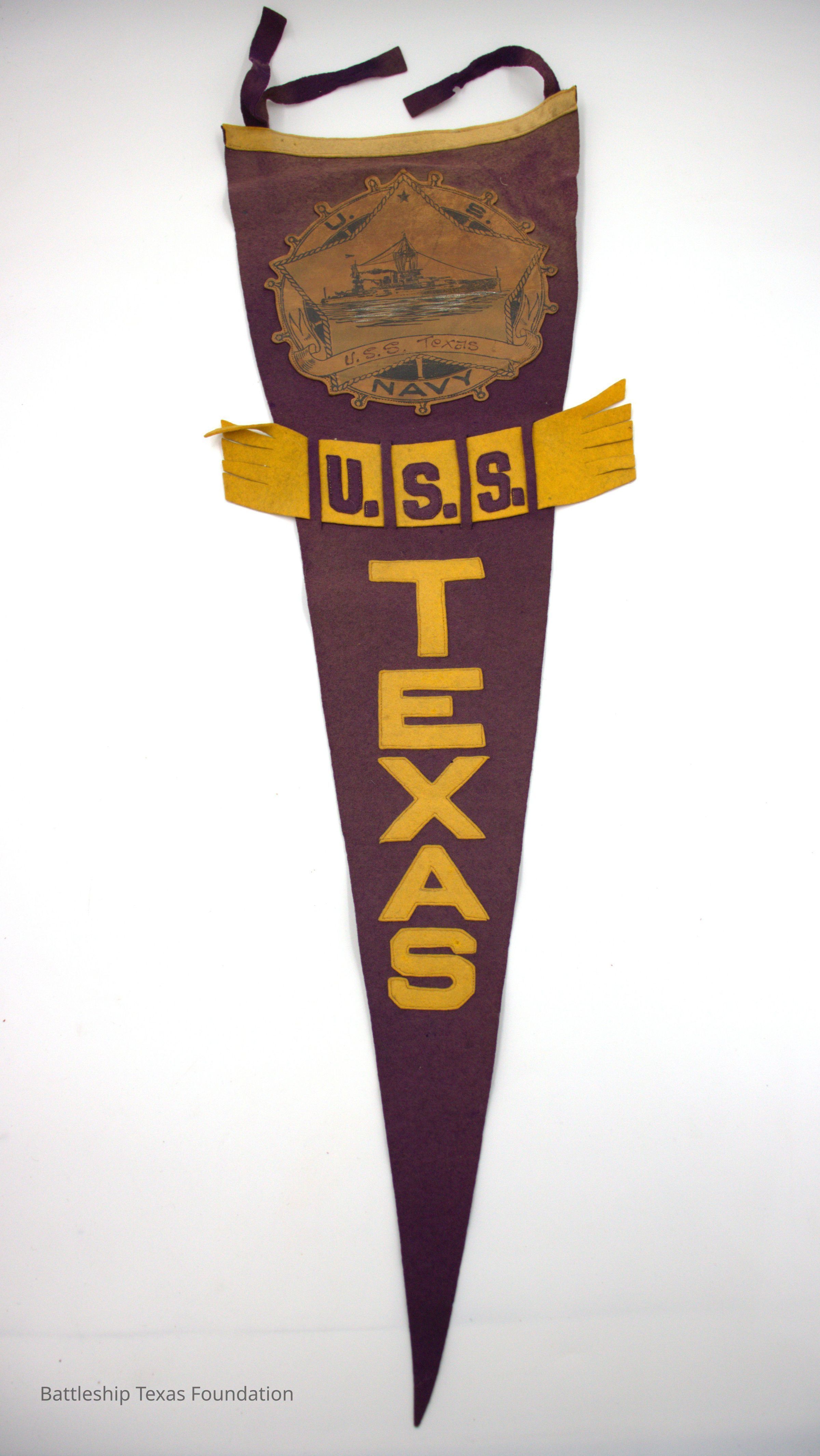


Pennant
Description
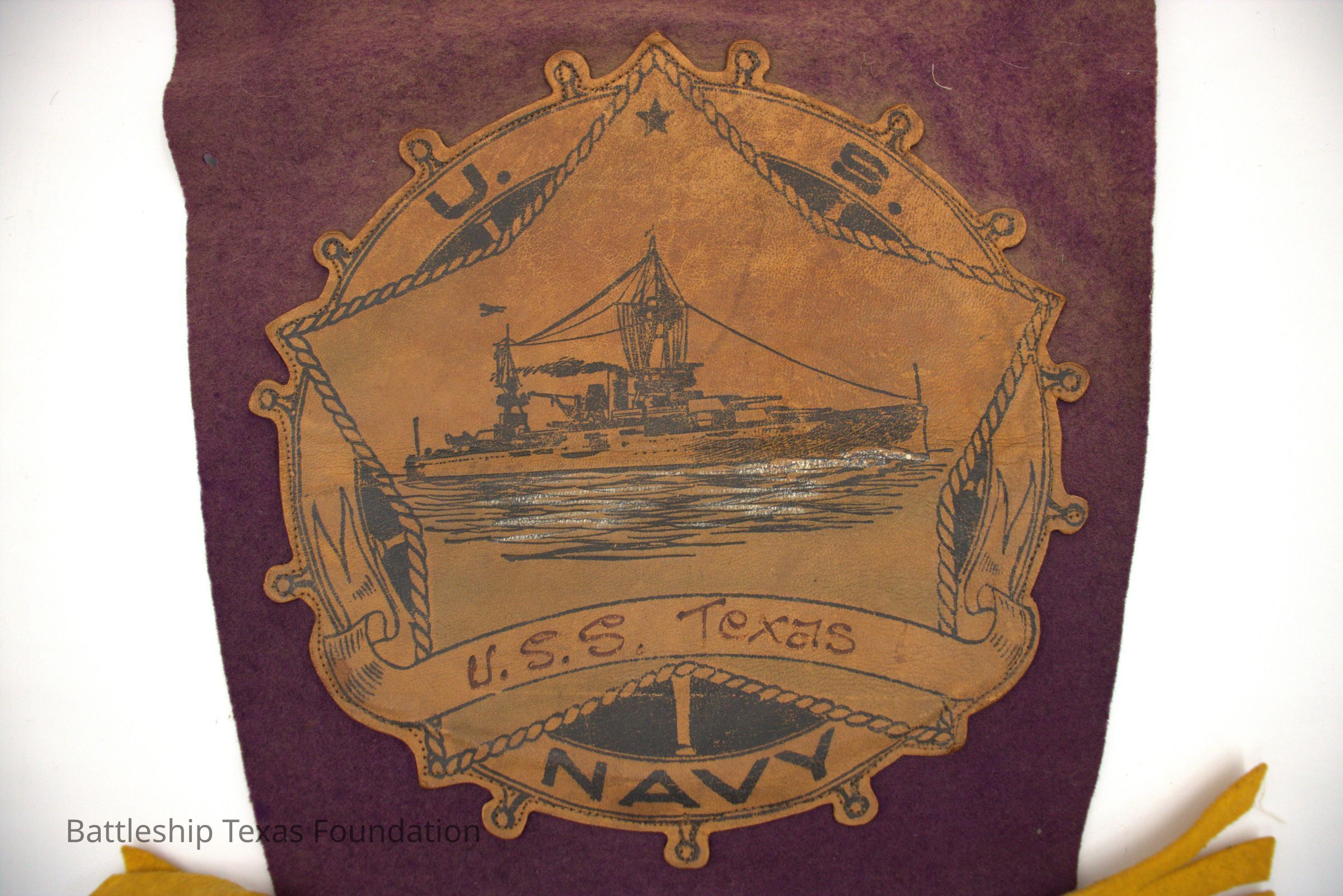
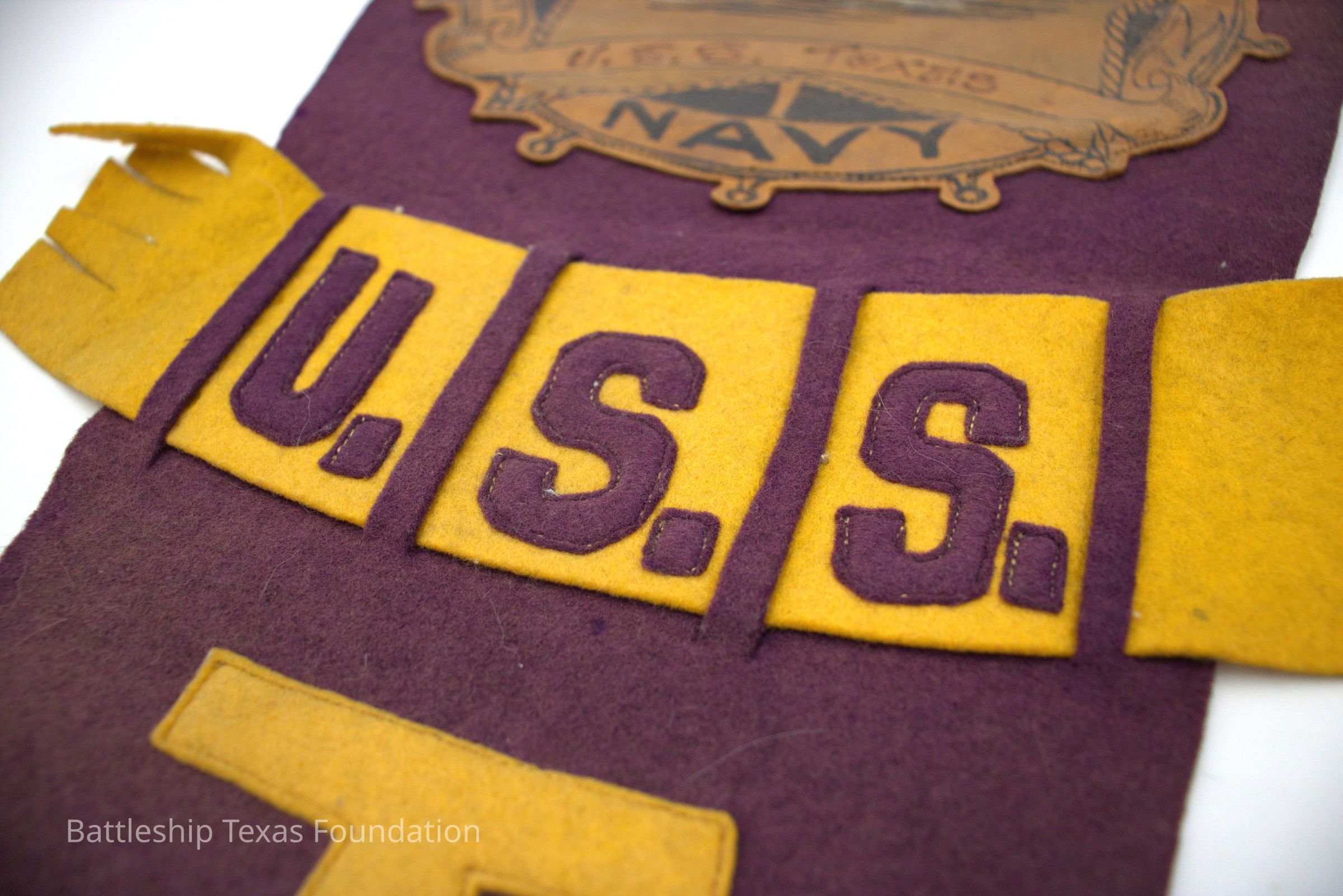
Purple and yellow triangular felt pennant. At the widest end of the pennant, the top end, is two ties on one side and one tie on the other. is a sewn on leather emblem. the emblem appears to be cut from a leather bound photo album cover. The emblem is in the shape of a wheel with a star overlaid over it with a ship in the center of the star. Below that is "USS Texas" hand written on the emblem. "USS" spelled out in cut out yellow felt letters horizontally across it; "TEXAS" is spelled out in cut out yellow felt letters vertically under the "USS".
Context
Hand-made pennant made using elements on photo album covers. Many crew members kept photo albums that each have hundreds of photos chronicling their service onboard.
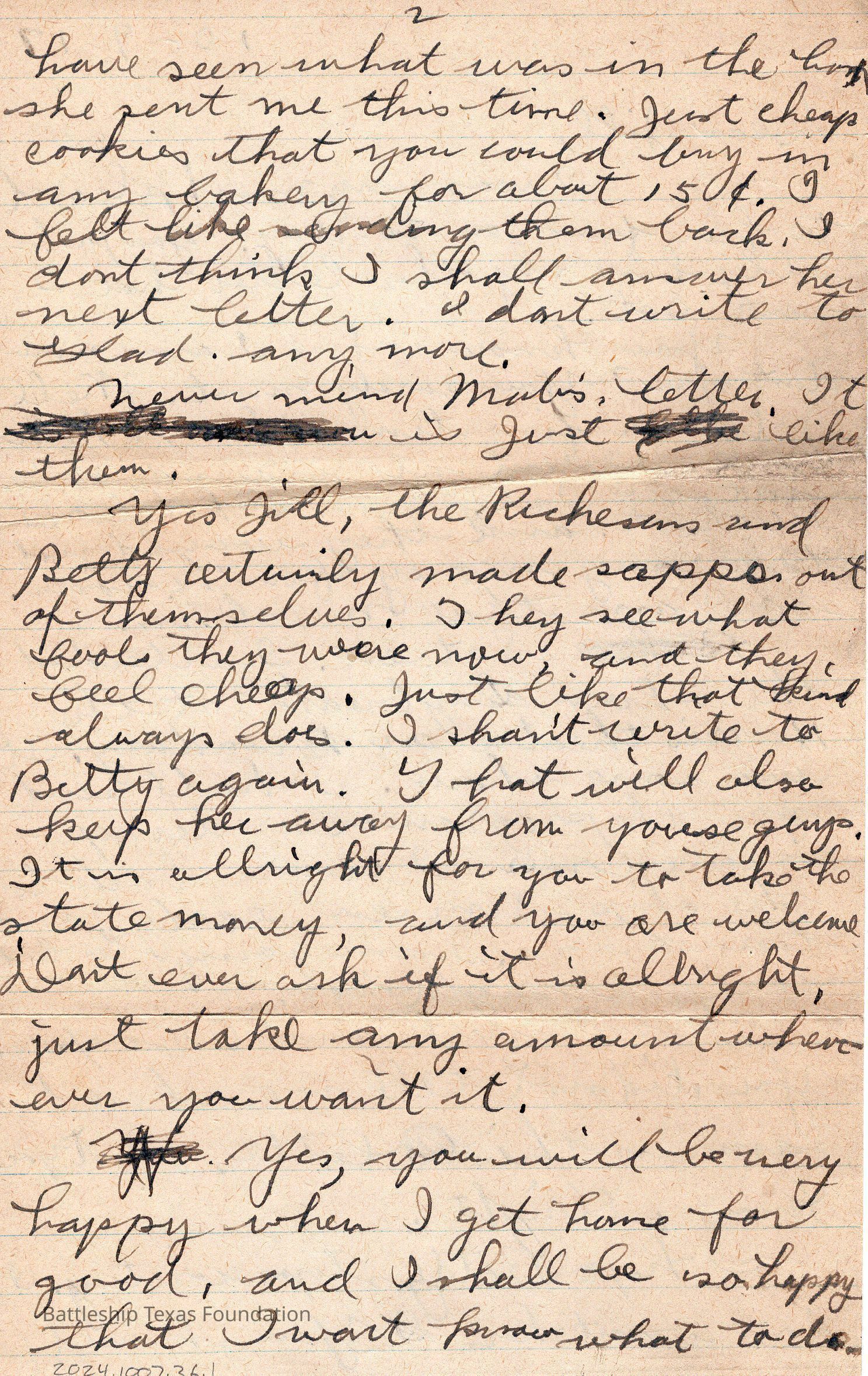
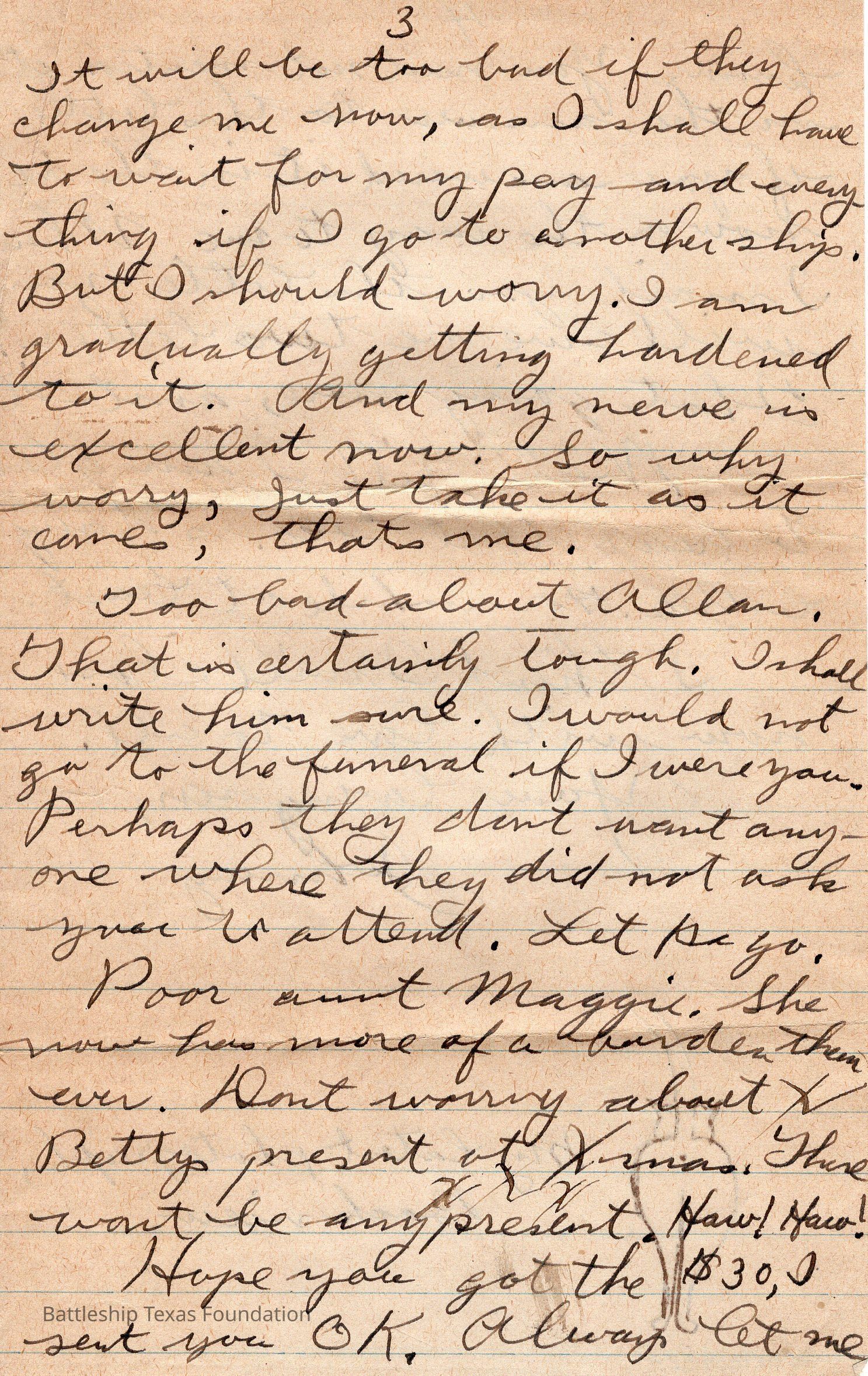
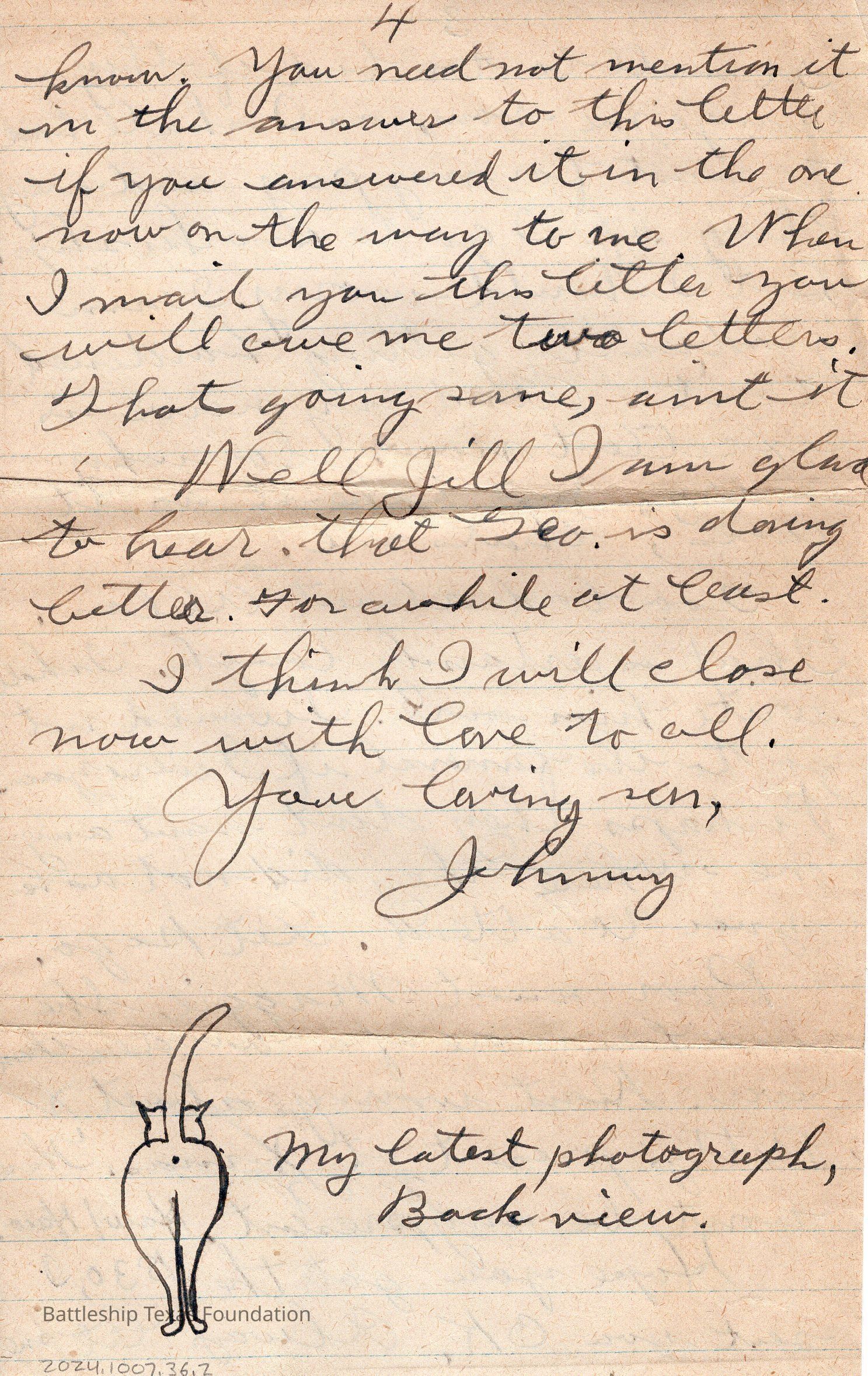
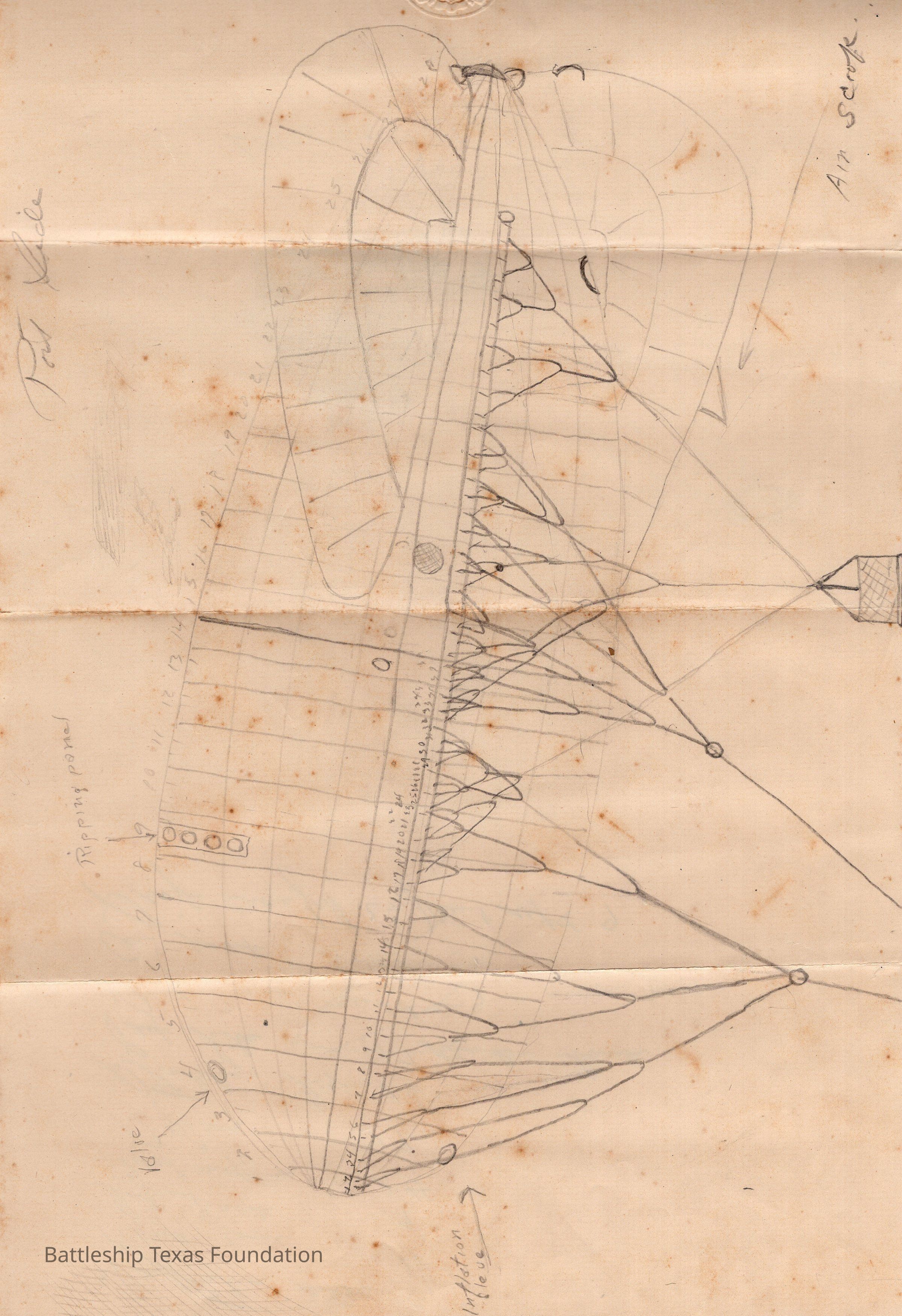
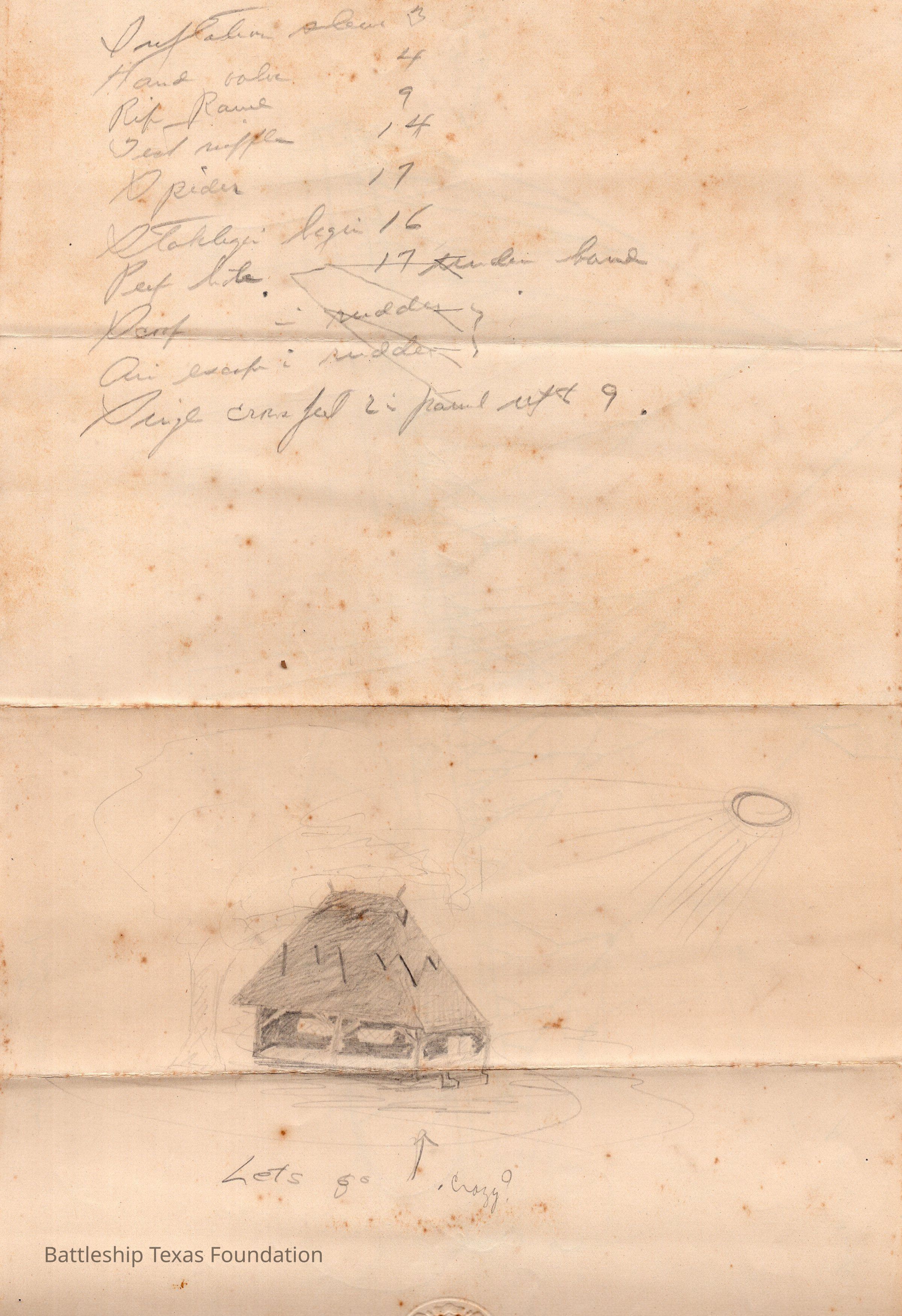
During the early history of Battleship Texas and especially during World War I, art was done sparingly in free moments or snuck in while on duty. Much that was done was in the form of sketches with pencil and paper. John F. Lamson, a machinist mate during World War I occasionally graced the back of letters to his family with sketches of cat behinds and remarked on his “latest photograph.” Another crew member, William K. Wilbur was sent to train in kite balloon operations at the Royal Naval Air School in Roehampton, England during the war. While his notes are filled with sketches of balloons, circuit diagrams, and myriad notes recorded to page, the back of one shows a bungalow resting in the shade of a large tree as the sun beats down overhead. A simple note adorns the bottom, “Let’s go” with an arrow pointing to the sketch and, “Crazy?” Whether Lamson’s move to humor, or Wilbur’s desire for a tropical respite, both men demonstrated a desire for reprieve from their current situation. Interestingly, Lamson’s sketches only appear on his letters before Texas made the journey to link with the British Grand Fleet, while none appear when on actual patrol, replaced with thoughts of anxiety and a desire to return home. Wilbur’s artwork demonstrates a similar sentiment, a desire to be elsewhere in the face of the Great War.
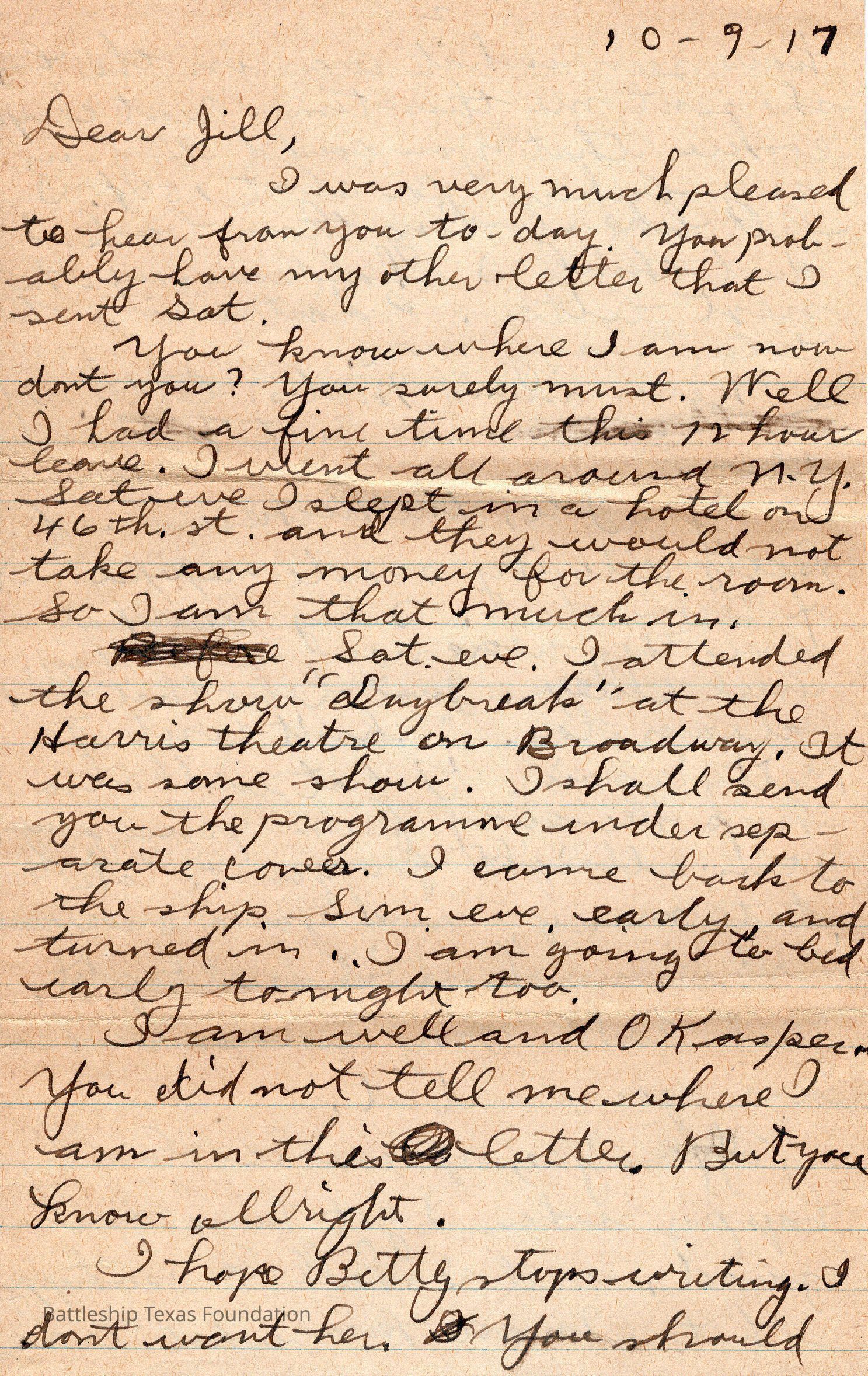
Lamson 1917/10/09 letter
Description
Dated 10-9-17 and addressed to Jill. back has "2" on center top.
Context
Battleship Texas ran aground on Block Island on September 28, 1917. She underwent repairs in New York Navy Yard and departed for Scapa Flow on January 30, 1918. John Lamson was a MM1c on Battleship Texas from May 1917 to June 1919. Throughout his time on Texas, he sent a letter to his family at least once a week, often more. Longer stretches of absence are explained either by movement across the Atlantic, or with the Grand Fleet. Battleship Texas had her own post office. All mail passed through a censor before leaving the ship. Once the package is checked, it was stamped with a “U.S.S. TEXAS” stamp. If in a port, mail could carry the markers of the post office on shore.
Kite Balloon drawing
Description
Drawing on paper of a kite balloon. Back has a sketch of a hut with "let's go" written under it. Other notes on top of back of page.
Context
Battleship Texas arrived in Scapa Flow on February 11, 1918, where she joined the British Grand Fleet. She patrolled the North Sea throughout 1918, escorted the German High Seas Fleet to surrender on November 21, and departed the Grand Fleet on December 1, 1918. William Wilbur served on Battleship Texas from December 1917 to August 1919. During WWI, he was selected to train on Kite Balloons at the Royal Naval Air School.
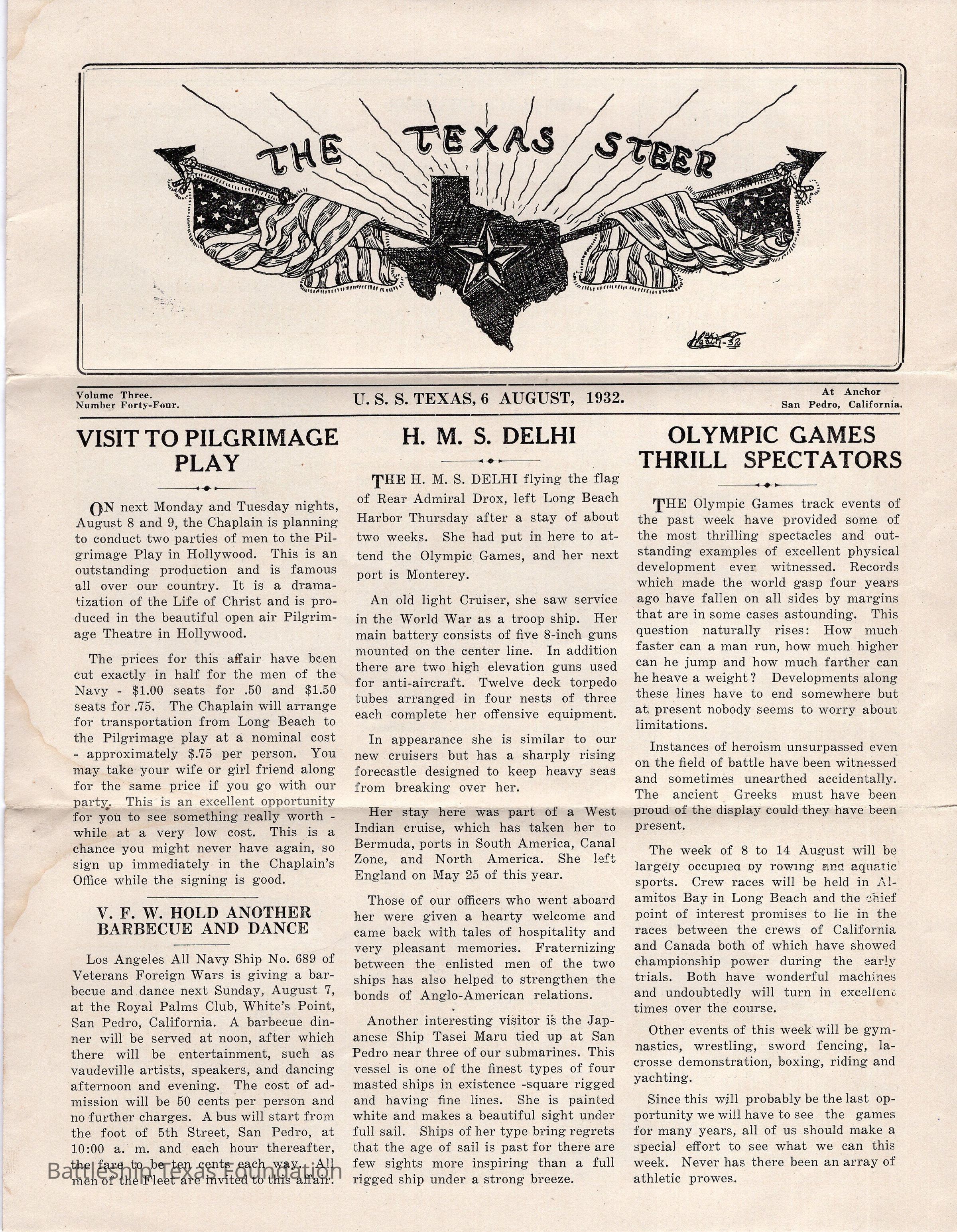
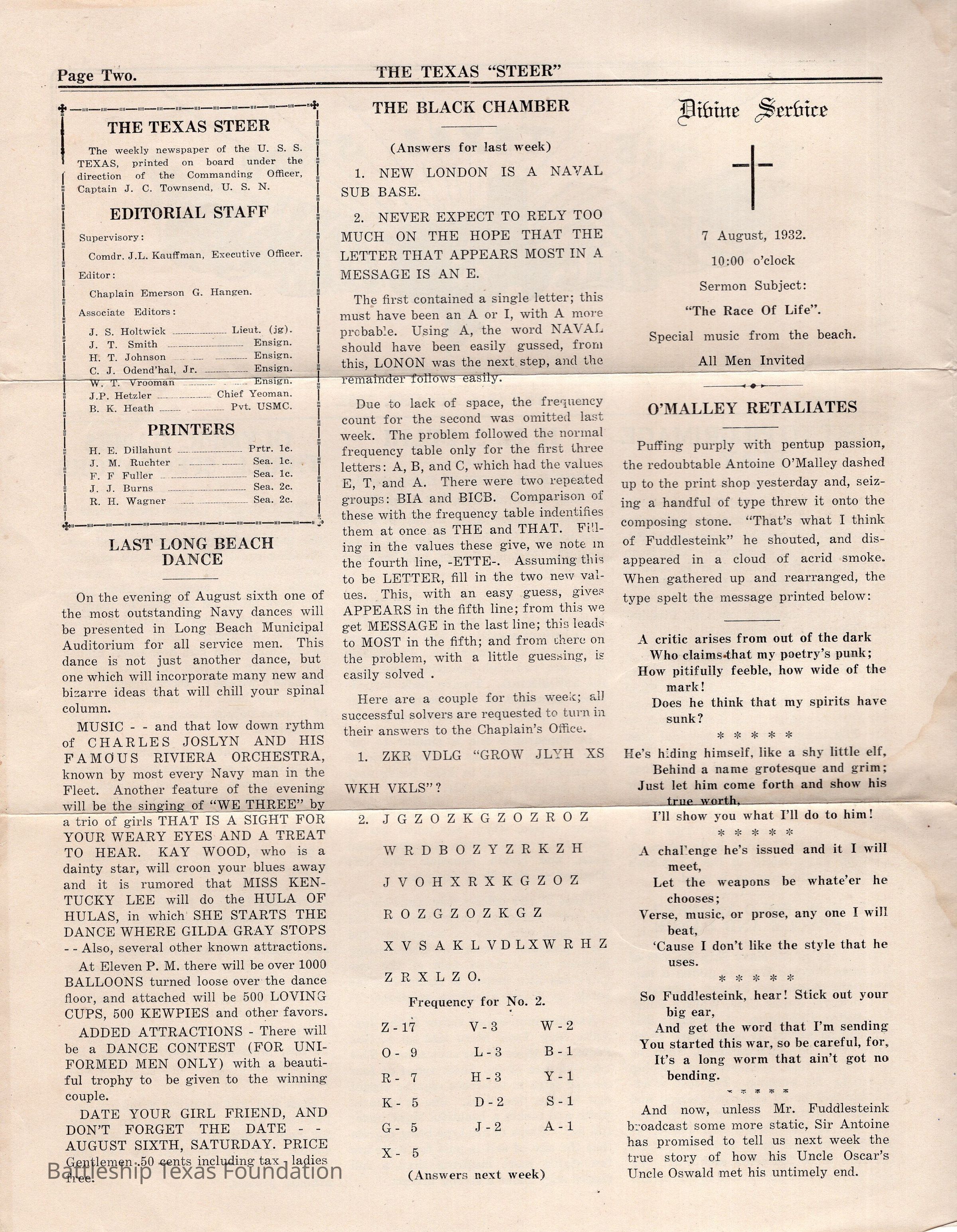
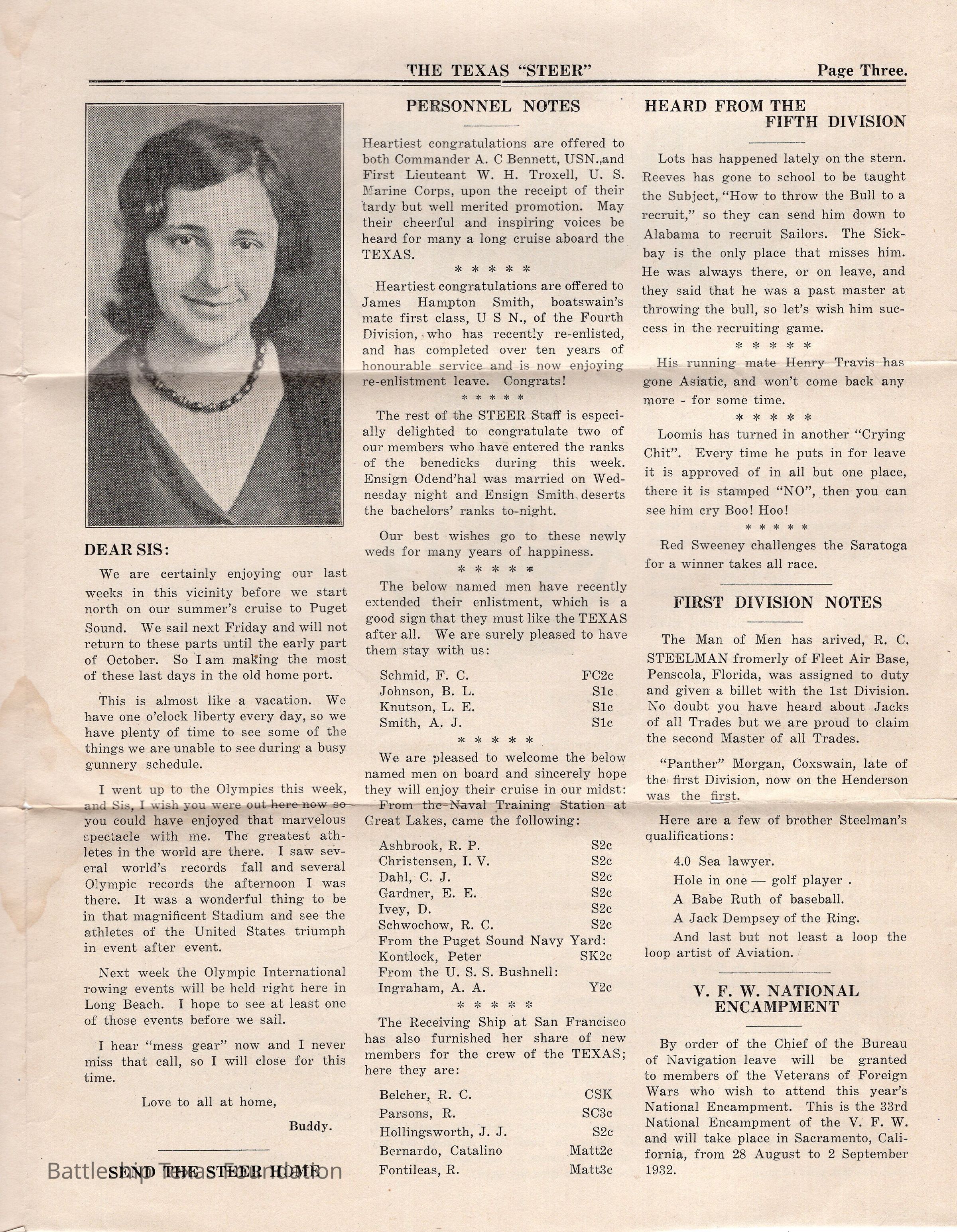
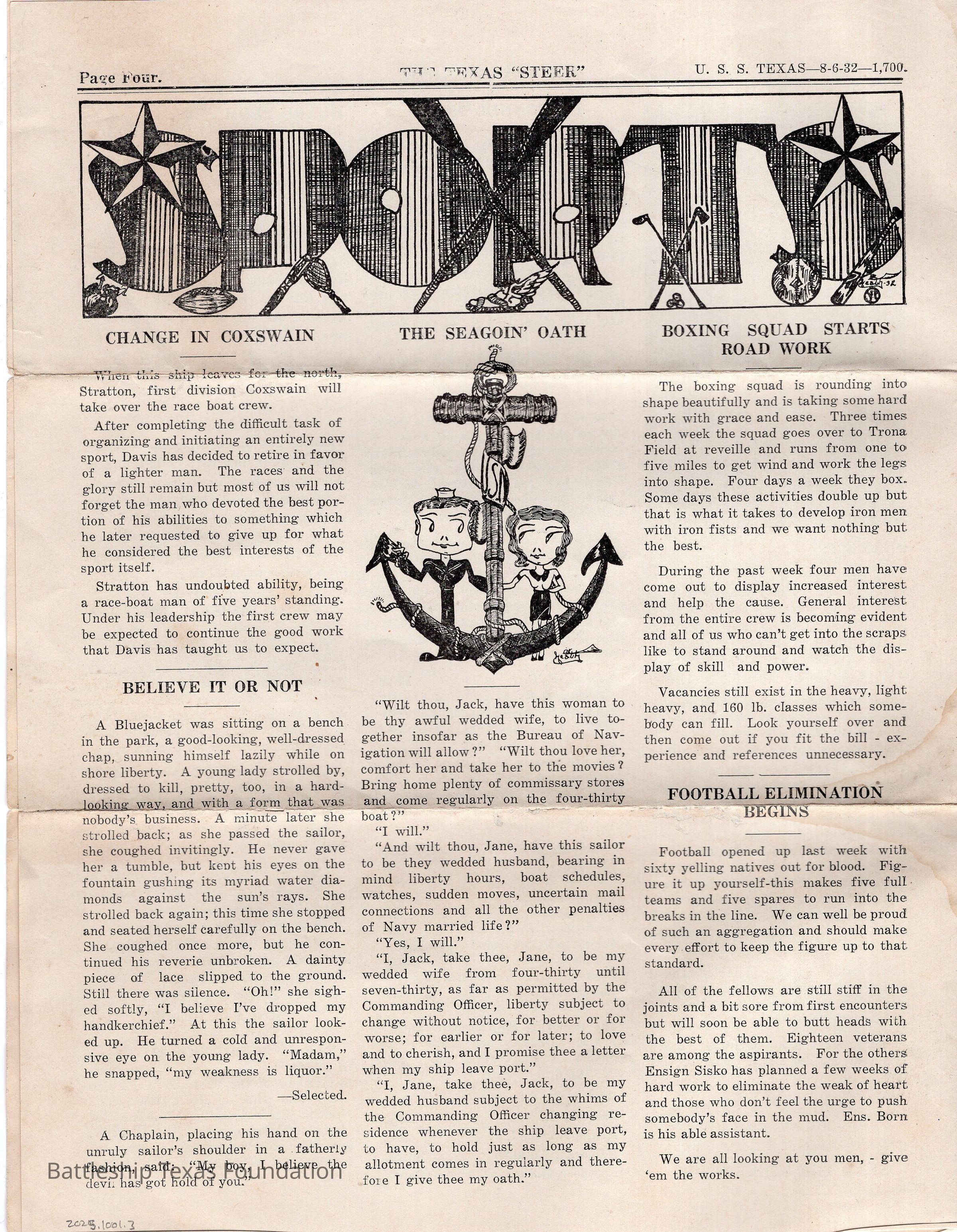
As Texas shifted into the interwar period, so too did the art that came from her crew. While prior pieces were for private and personal consumption, beginning in 1920, artwork began circulation throughout the entire ship. Cartoons and graphics were featured in both Battleship Texas magazines, The Texan (1920-1921) and The Texas Steer (1924-1936). These pieces were small and never intended to be the main focus of the issue, but they were drawn by her crew for her crew. Much of the cartoons in The Texan were done by the crew of Arkansas in their Arklight newsletter when crediting artists. Many of the graphics and cartoons for The Texas Steer were drawn by Buford K. Heath with some later editions being picked up by Elmer J. Birdsall. As the ship entered the 1930s, a more popular art form griped the US Navy. Birdsall went on to create many distinct naval covers, broadening the audience beyond the ship alone.
Texas Steer (Vol.3 No.44)
Description
Vol 3 No. 44 USS Texas published newspaper from 6 August, 1932 while she was at anchor in San Pedro, California. Artwork on front and back by Buford K. Heath.
Context
Battleship Texas was flagship of Battleship Division One from September 15, 1931, to June 27, 1937. She continued to participate in Fleet Problems throughout this period. “The Texas Steer” was a biweekly newsletter, started in 1924, and published by the crew of Battleship Texas. The paper was published until 1935, running a total of six volumes.
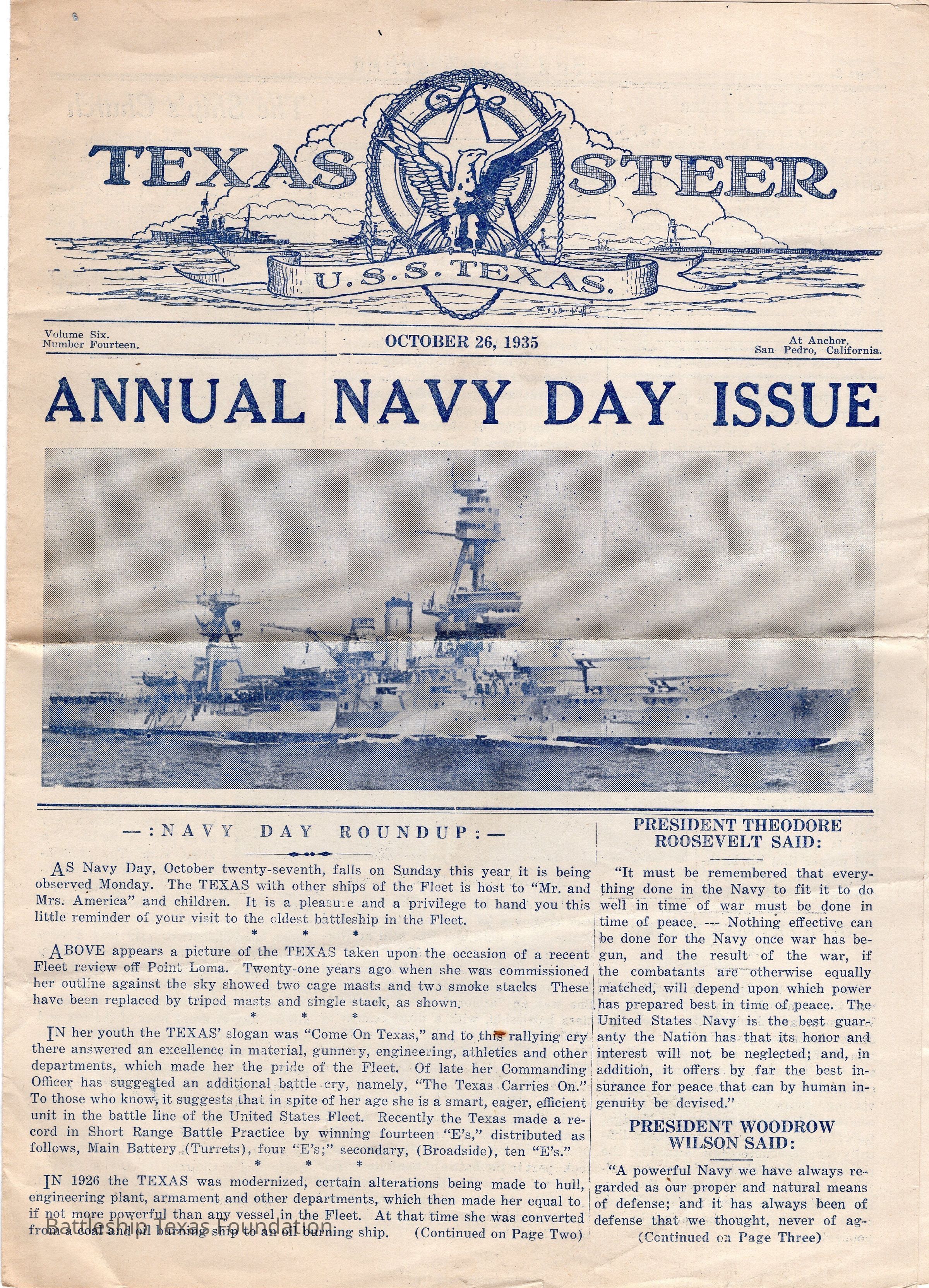
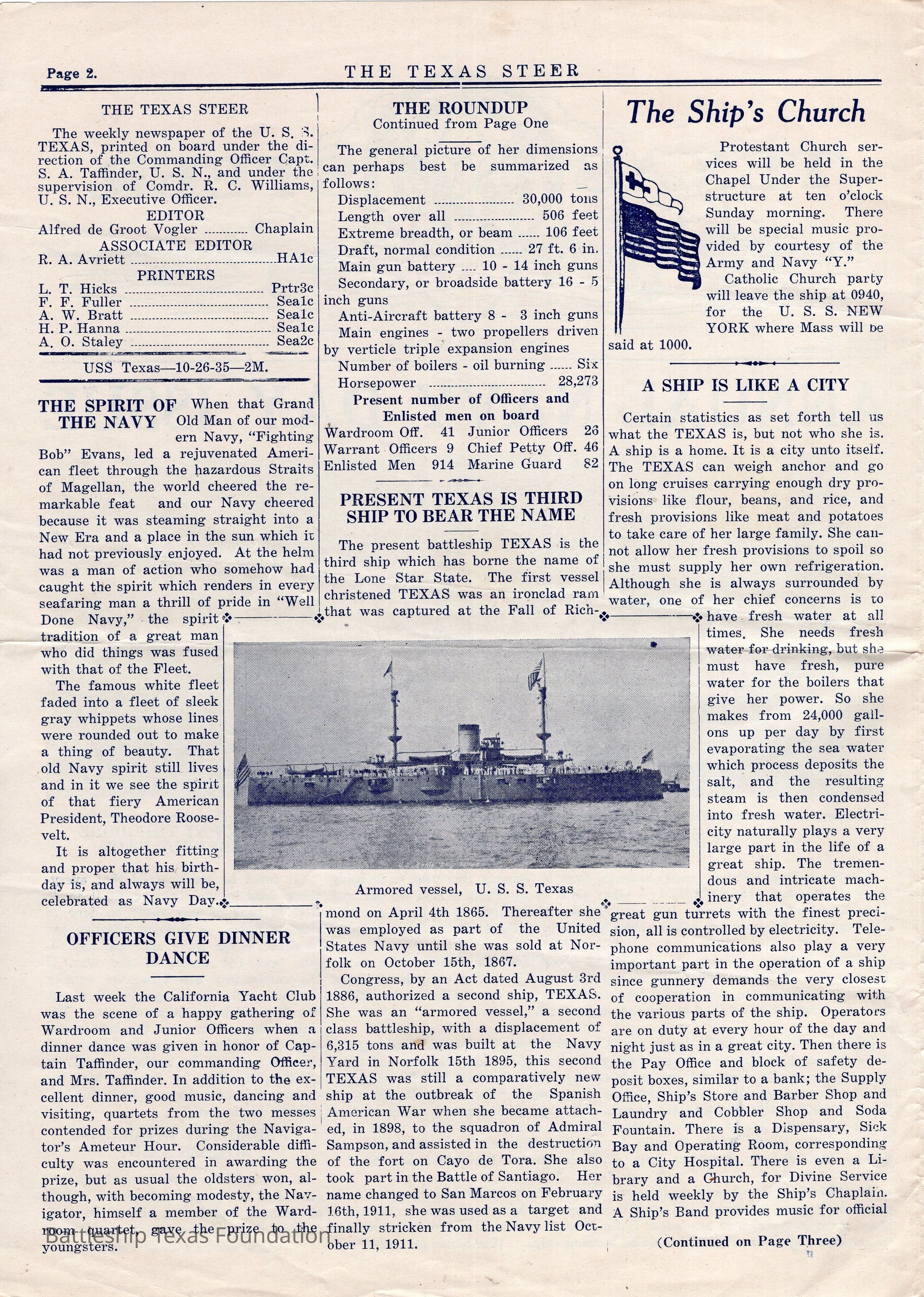
Texas Steer (Vol.6 No.14)
Description
Vol 6 No 14 USS Texas published newspaper's "ANNUAL NAVY DAY ISSUE" from October 26, 1935, while at anchor in San Pedro, California. Artwork on the front by Elmer J. Birdsall. Magazine donated by Keith Fessenden.
Context
Battleship Texas was flagship of Battleship Division One from September 15, 1931, to June 27, 1937. She continued to participate in Fleet Problems throughout this period. “The Texas Steer” was a biweekly newsletter, started in 1924, and published by the crew of Battleship Texas. The paper was published until 1935, running a total of six volumes.
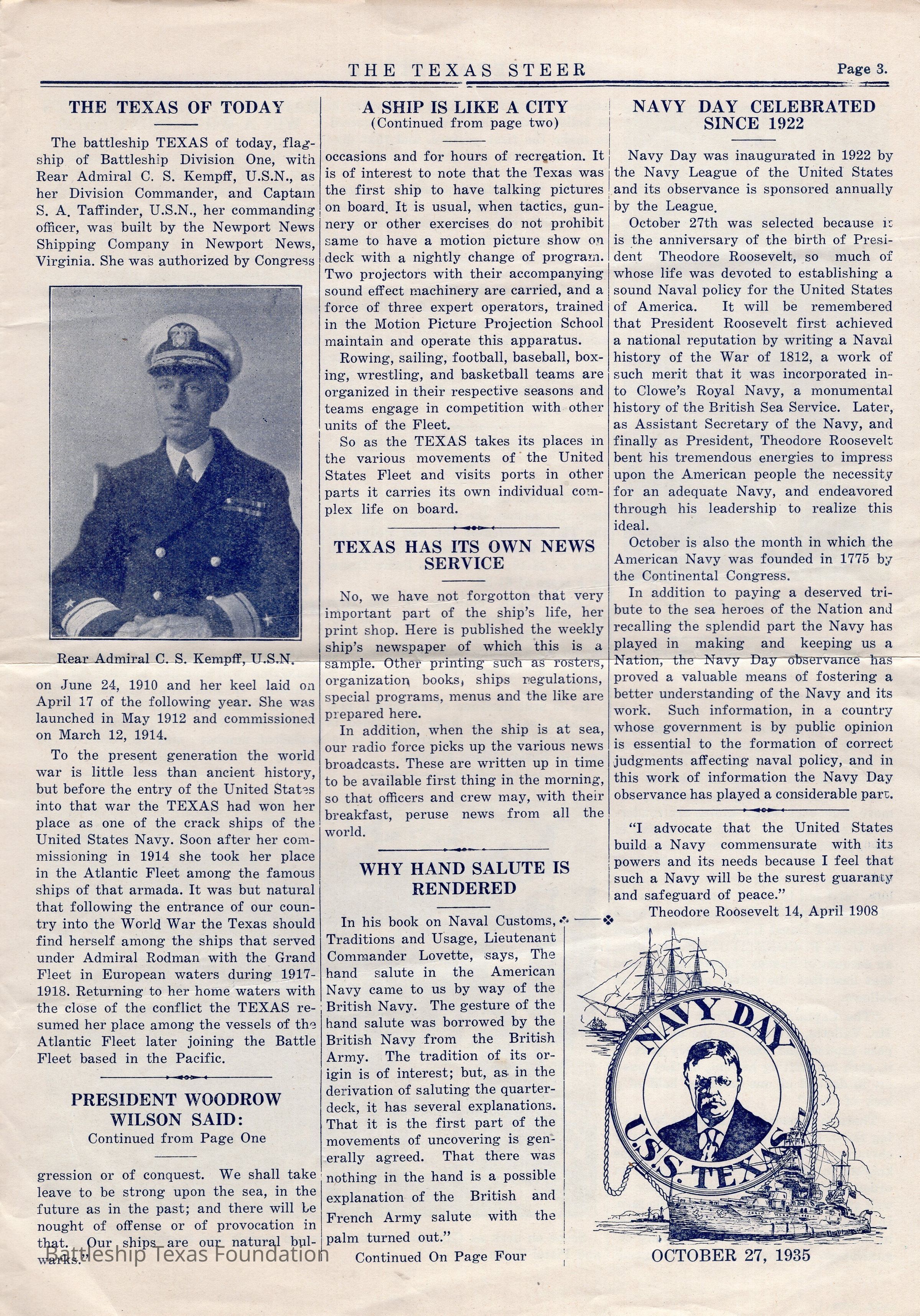
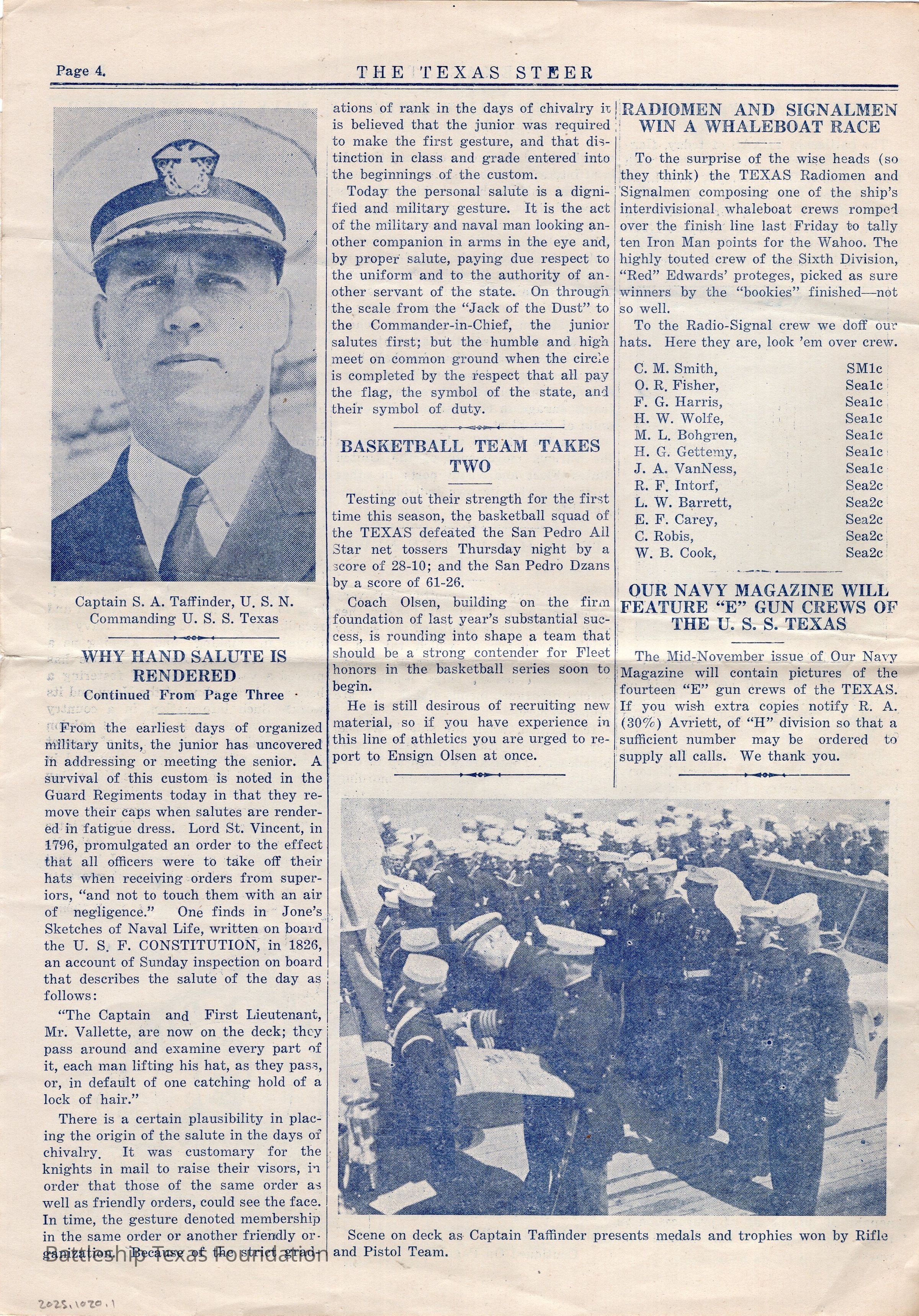
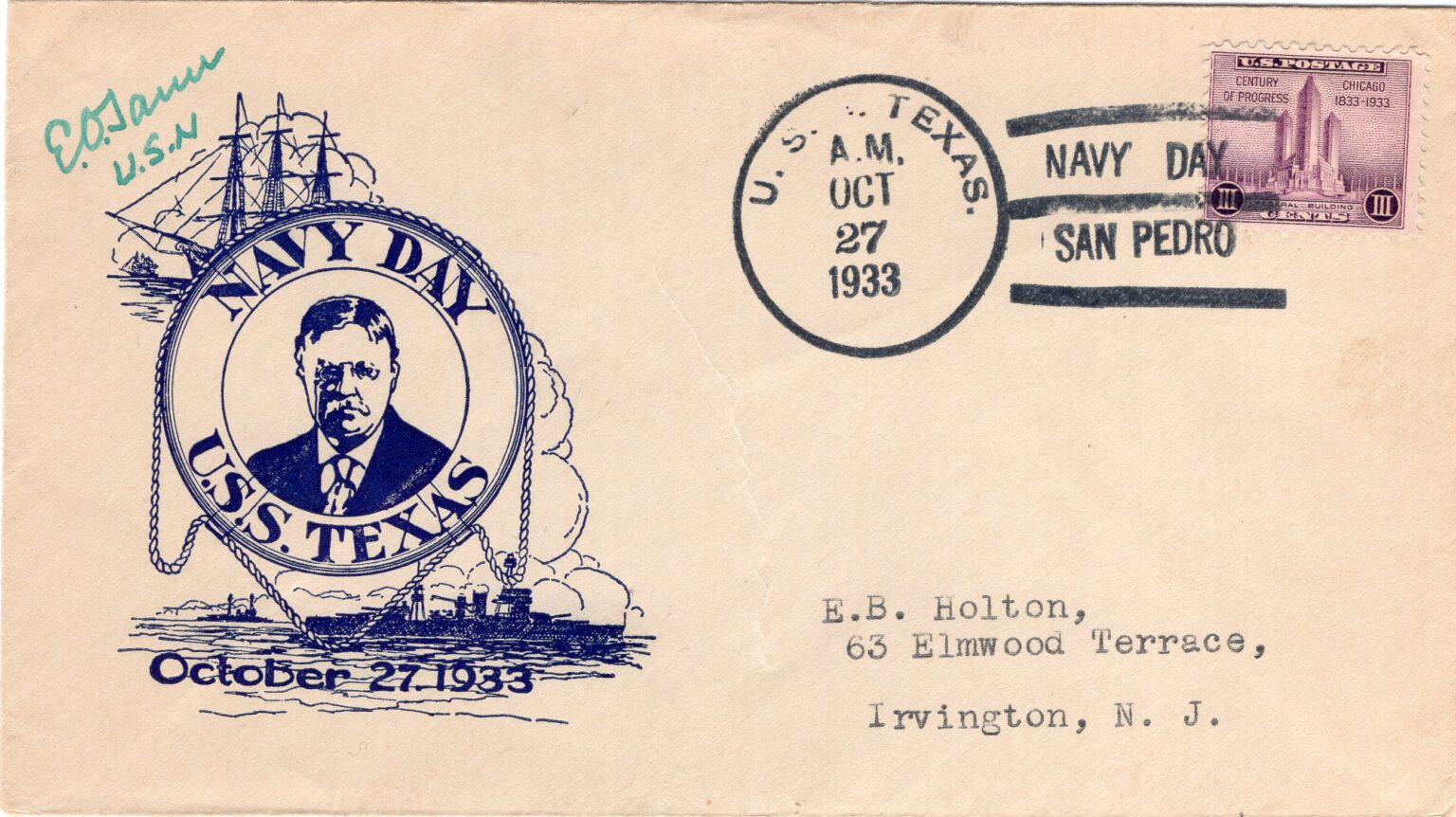
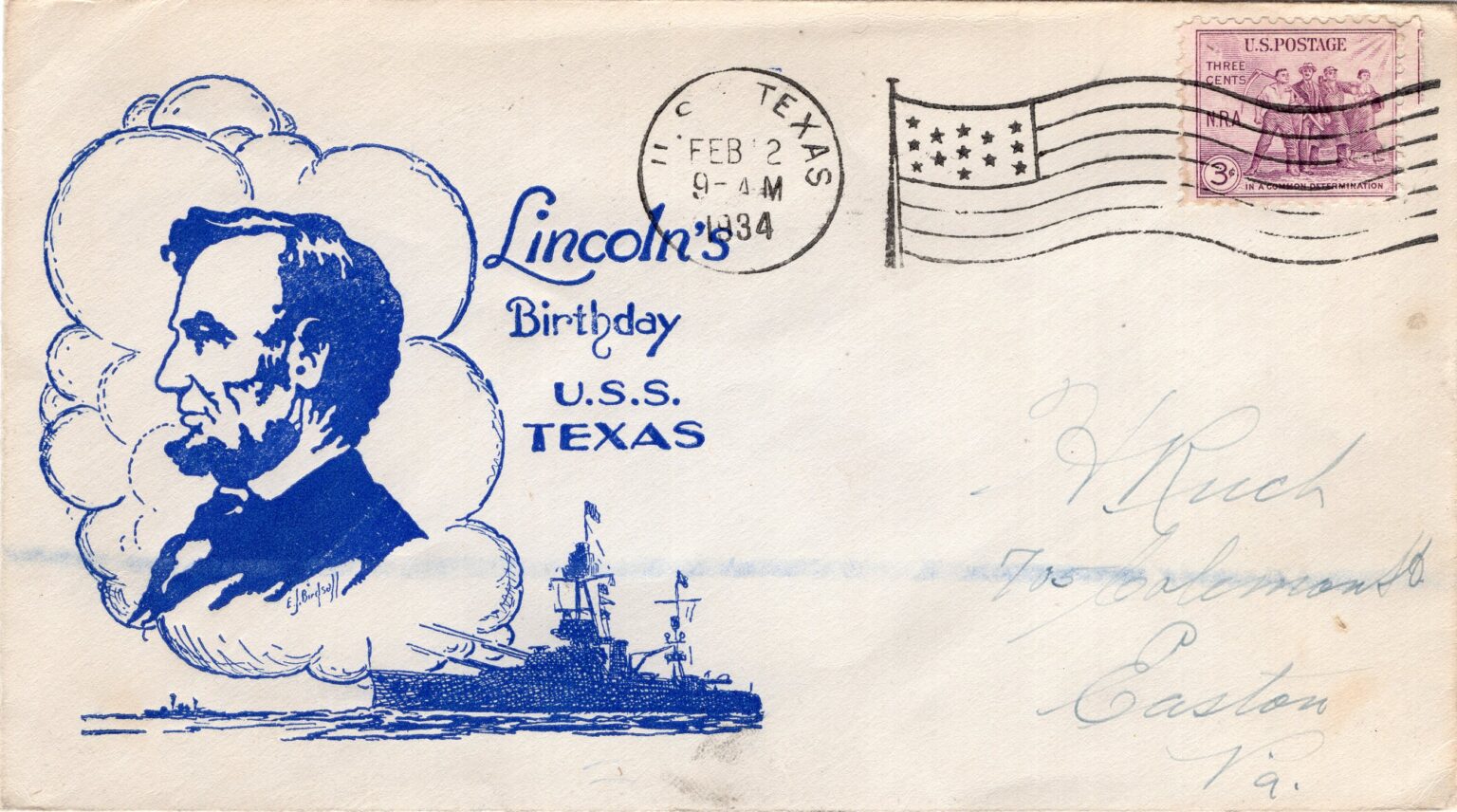
Many crew members spread their art throughout the ship and beyond to the homefront. Men on Texas sponsored and designed naval covers for envelopes in a practice that became heavily popularized in the 1930s. The trend was not unique to Texas, and widely featured throughout the entire fleet. Covers could encompass a wide variety of modes. Collage, small oil painting directly on the envelope, stickers or pasted on cutouts, and even just pen and pencil were common. The most common variant on Texas was block printing, using ink stamps to decorate many different envelopes and allowing a single design a wider audience. The practice was most popular on holidays and special events when and where the ship may be. Designs were typically monochromatic, where multiple colors often indicated a confluence of individual illustrations. Eric O. Tauer, Sidney N. Bremer, and Elmer J. Birdsall were amongst the more prolific designers and heavily feature on many envelopes donated to Battleship Texas Foundation. While they would again adorn the faces of envelopes following World War II, the war years saw a hiatus from the activity in lieu of more cost-effective methods of mail transportation which relegated envelopes unnecessary.
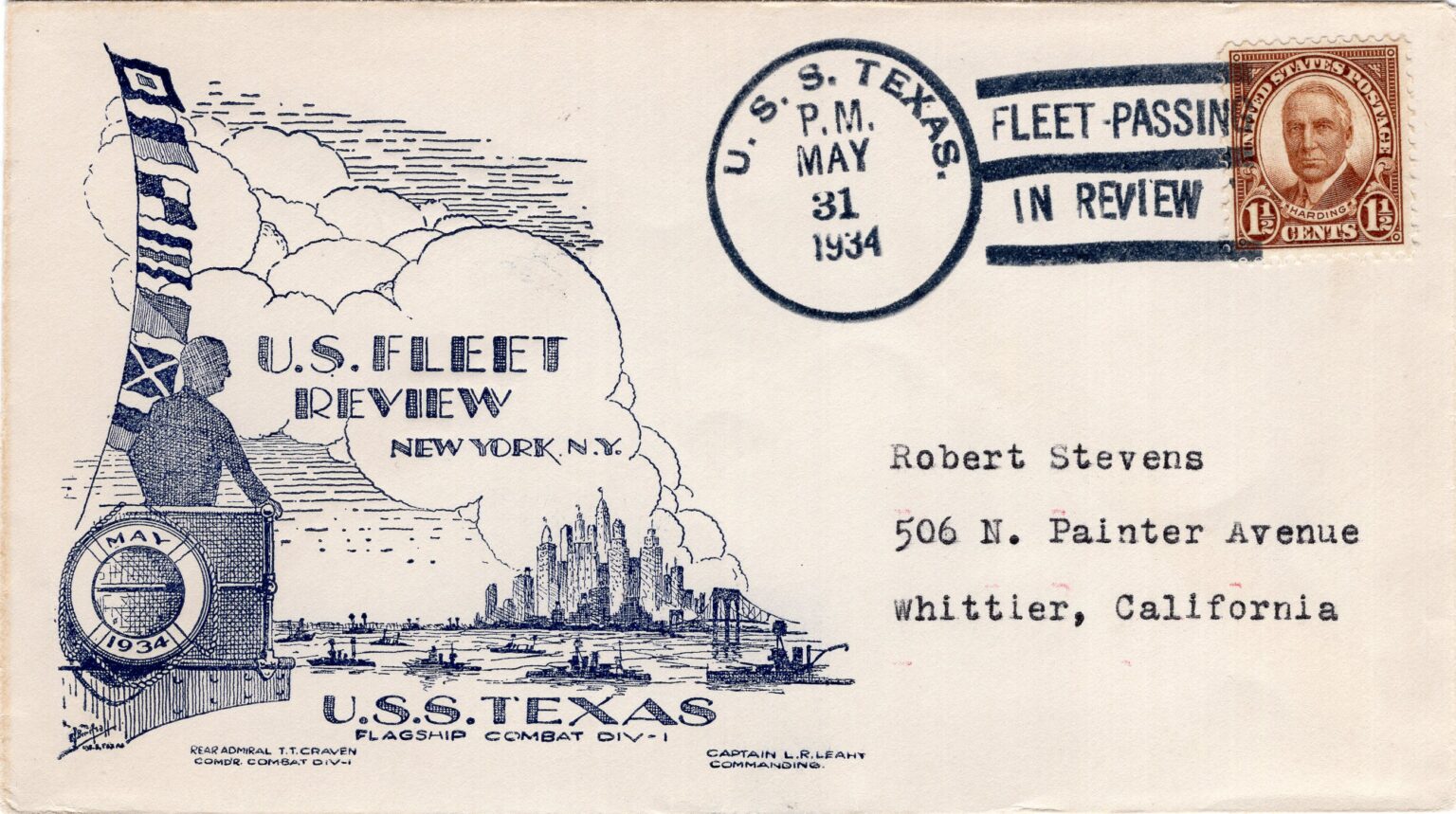
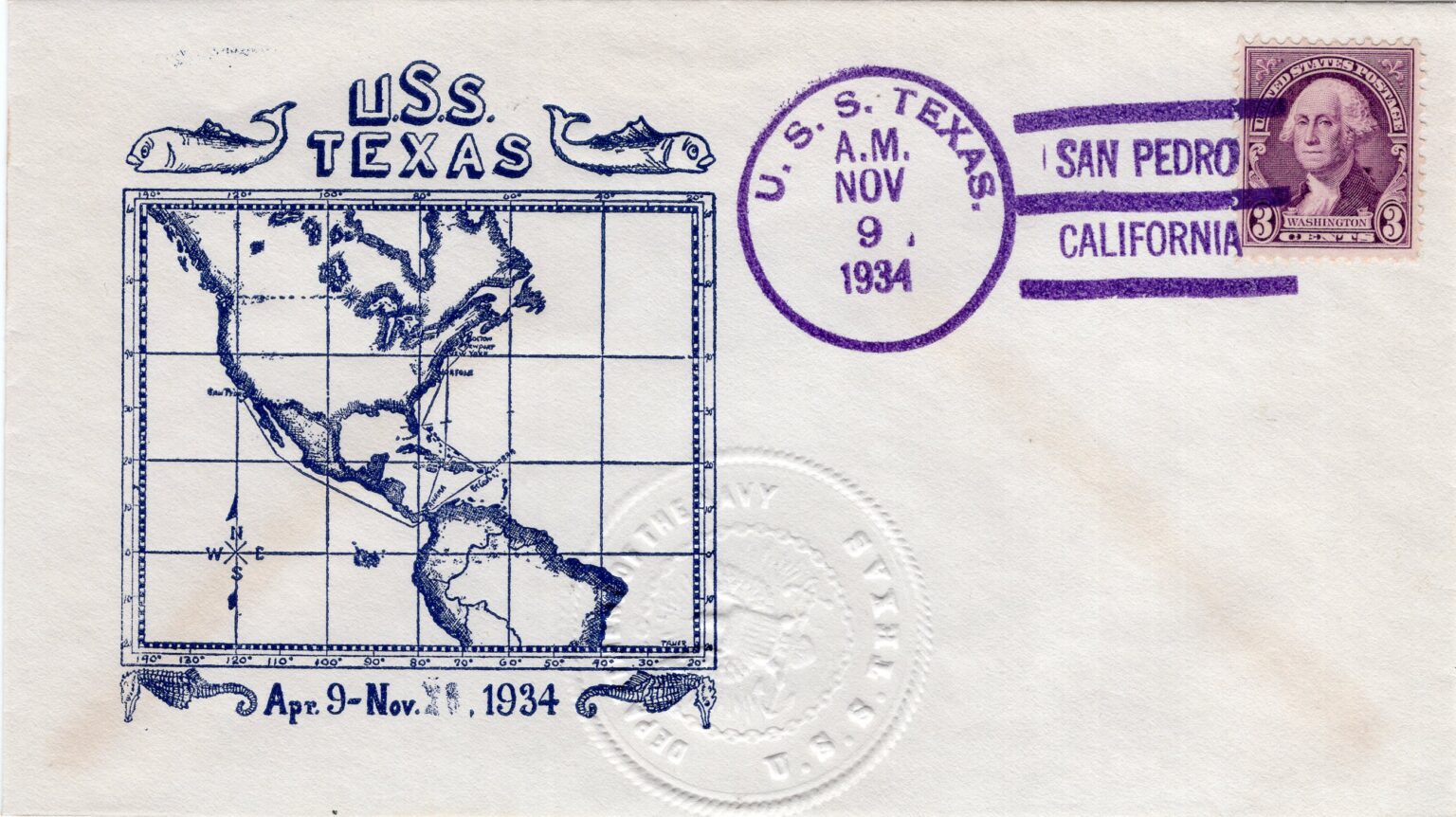
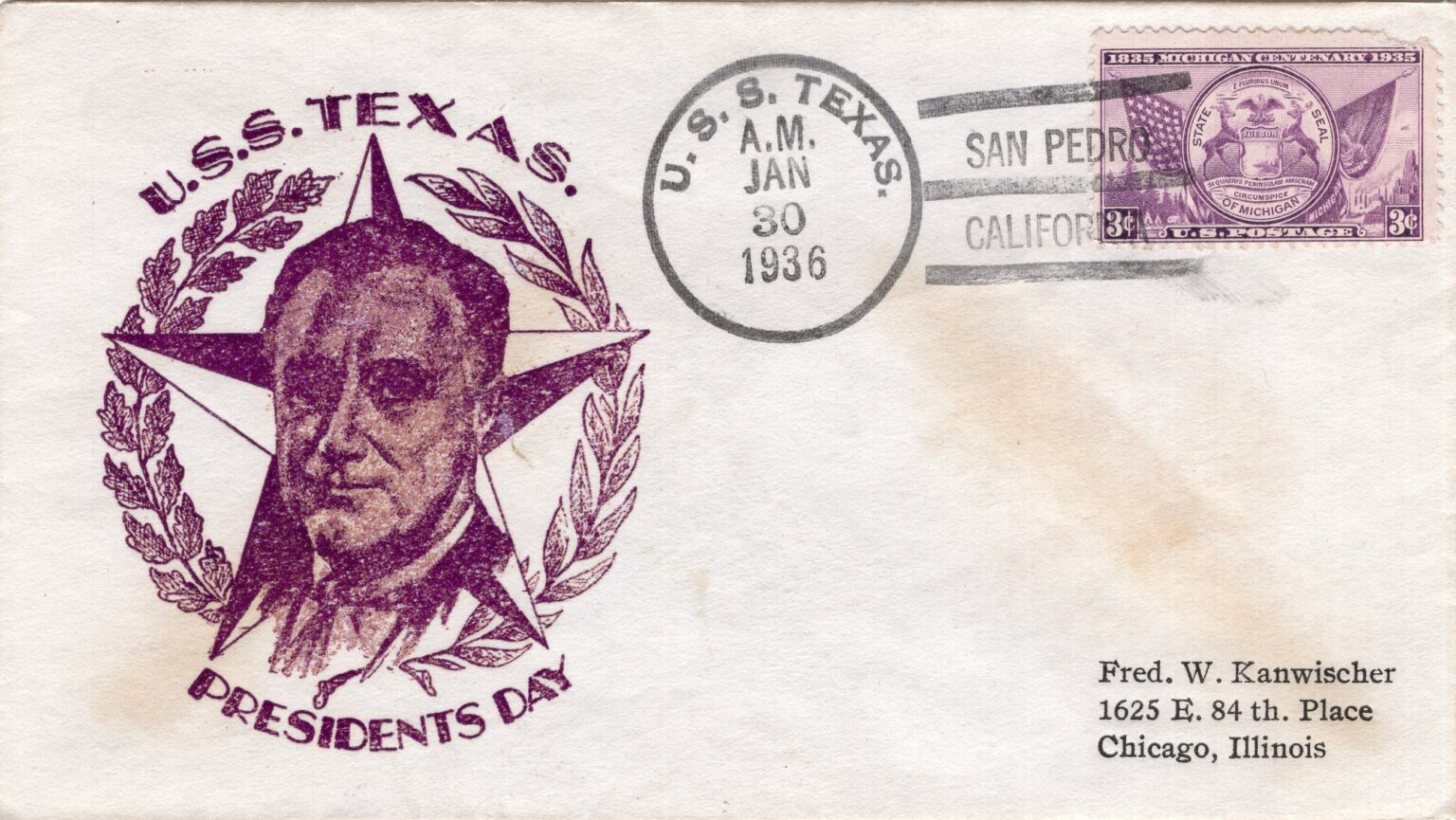
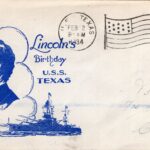
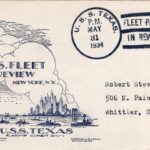
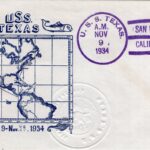
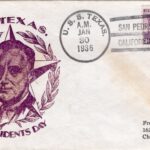
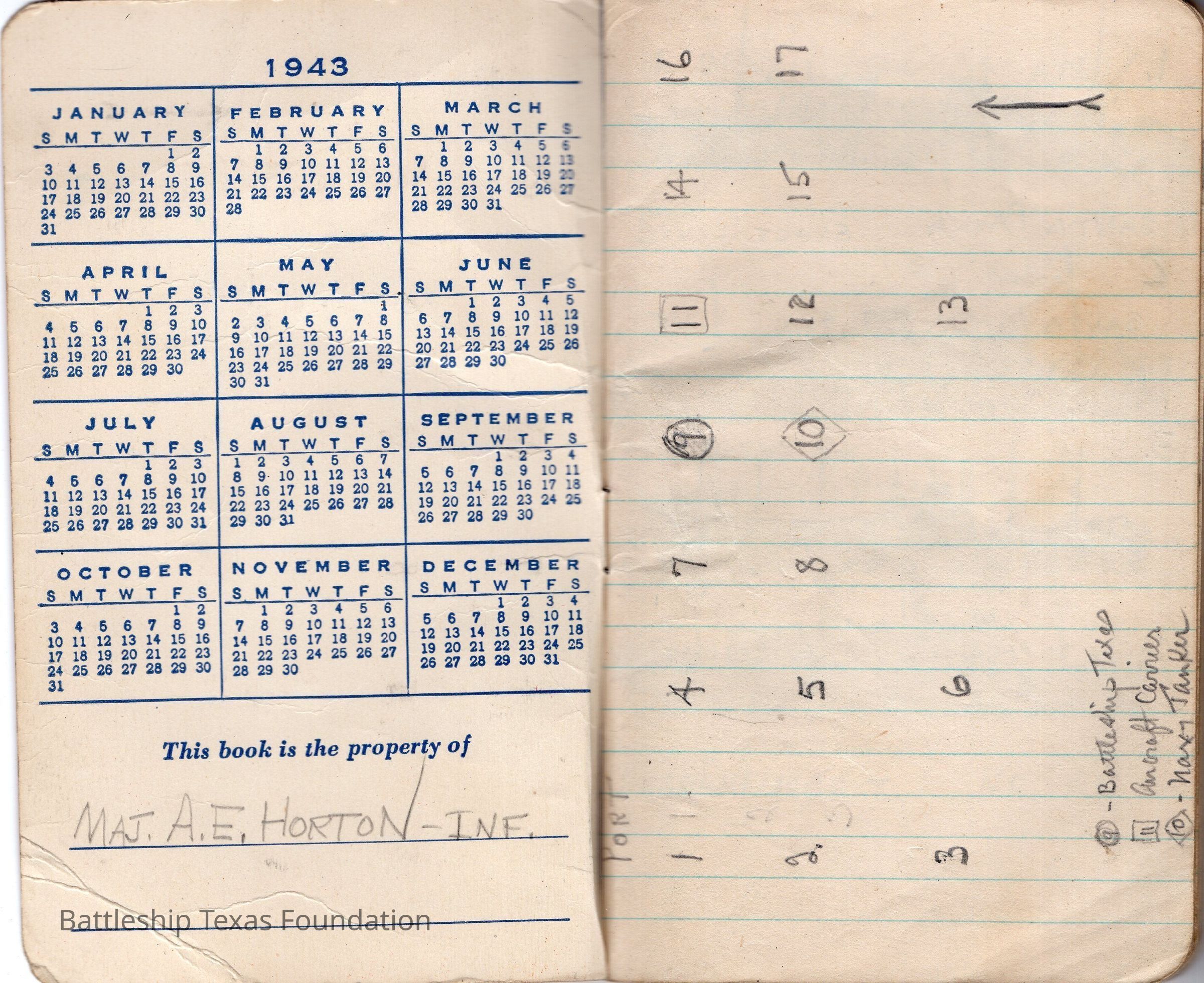
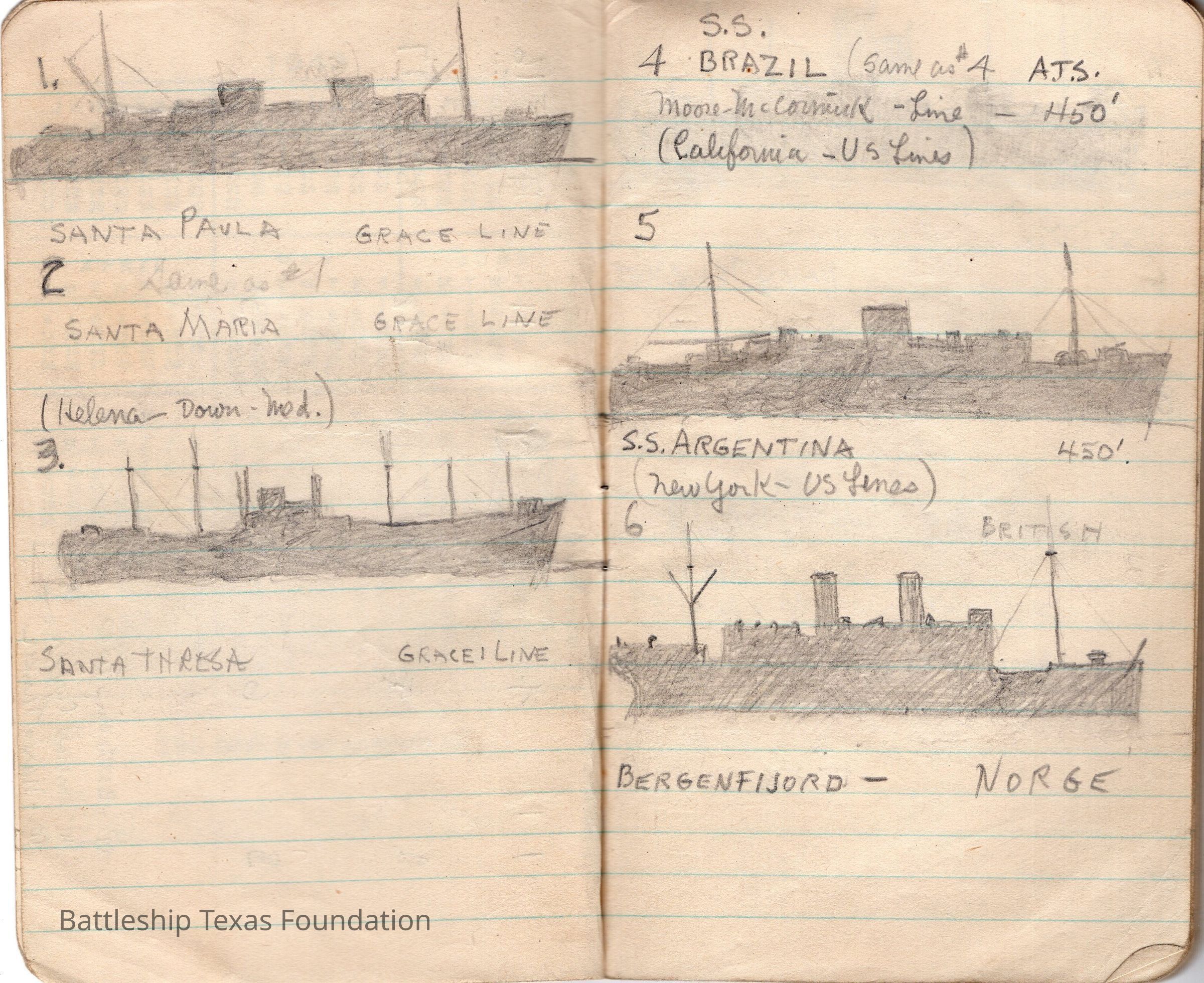
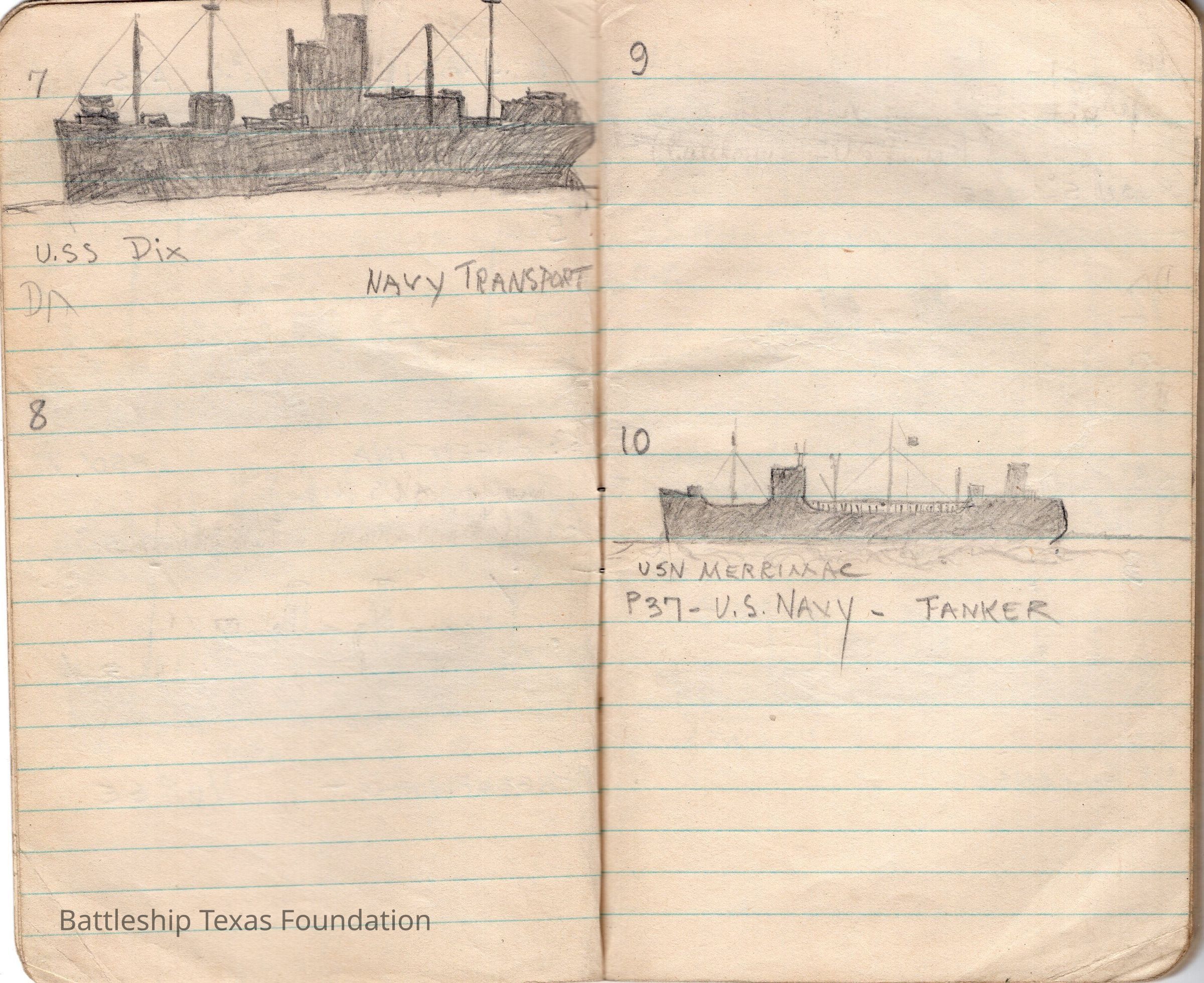
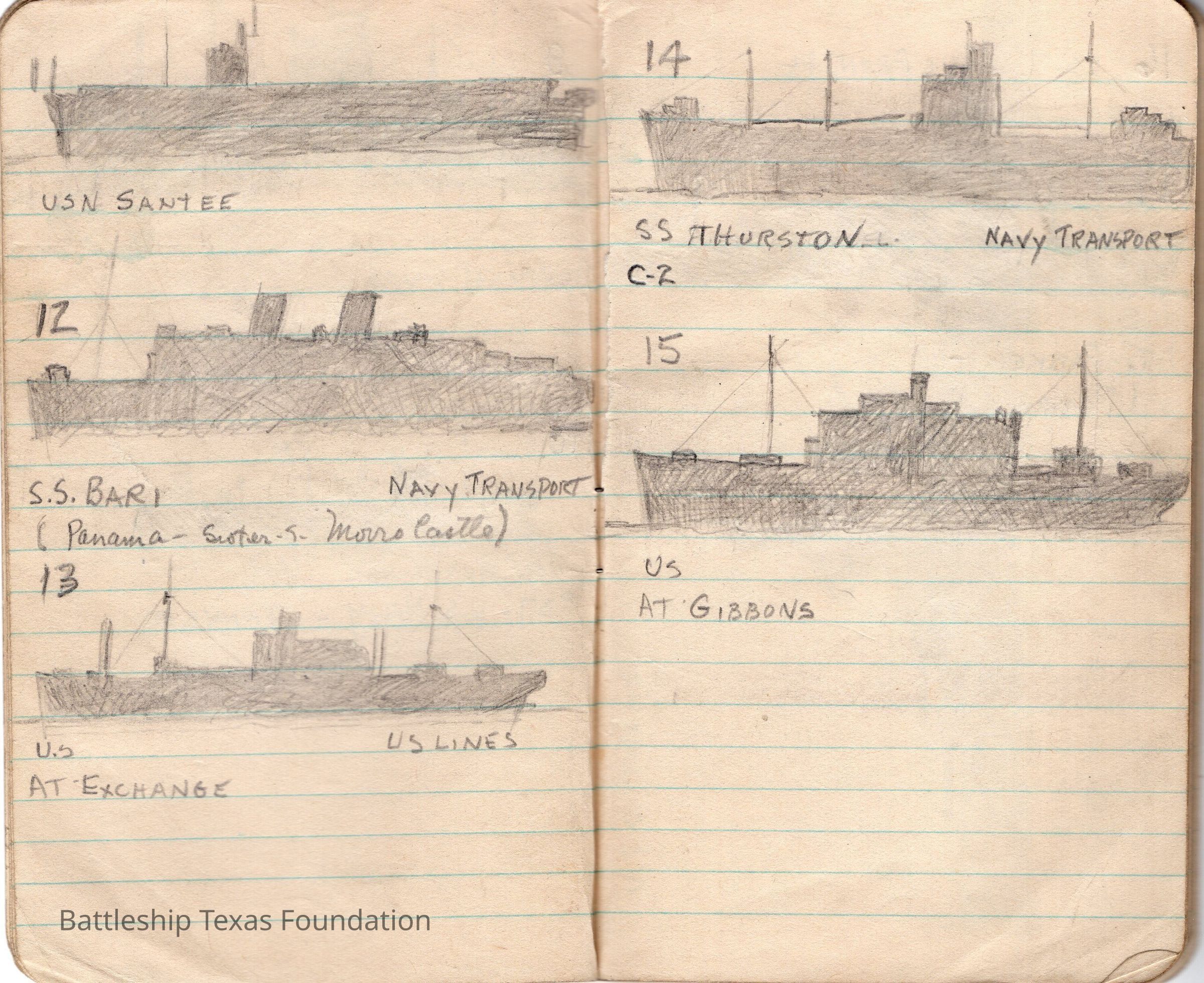
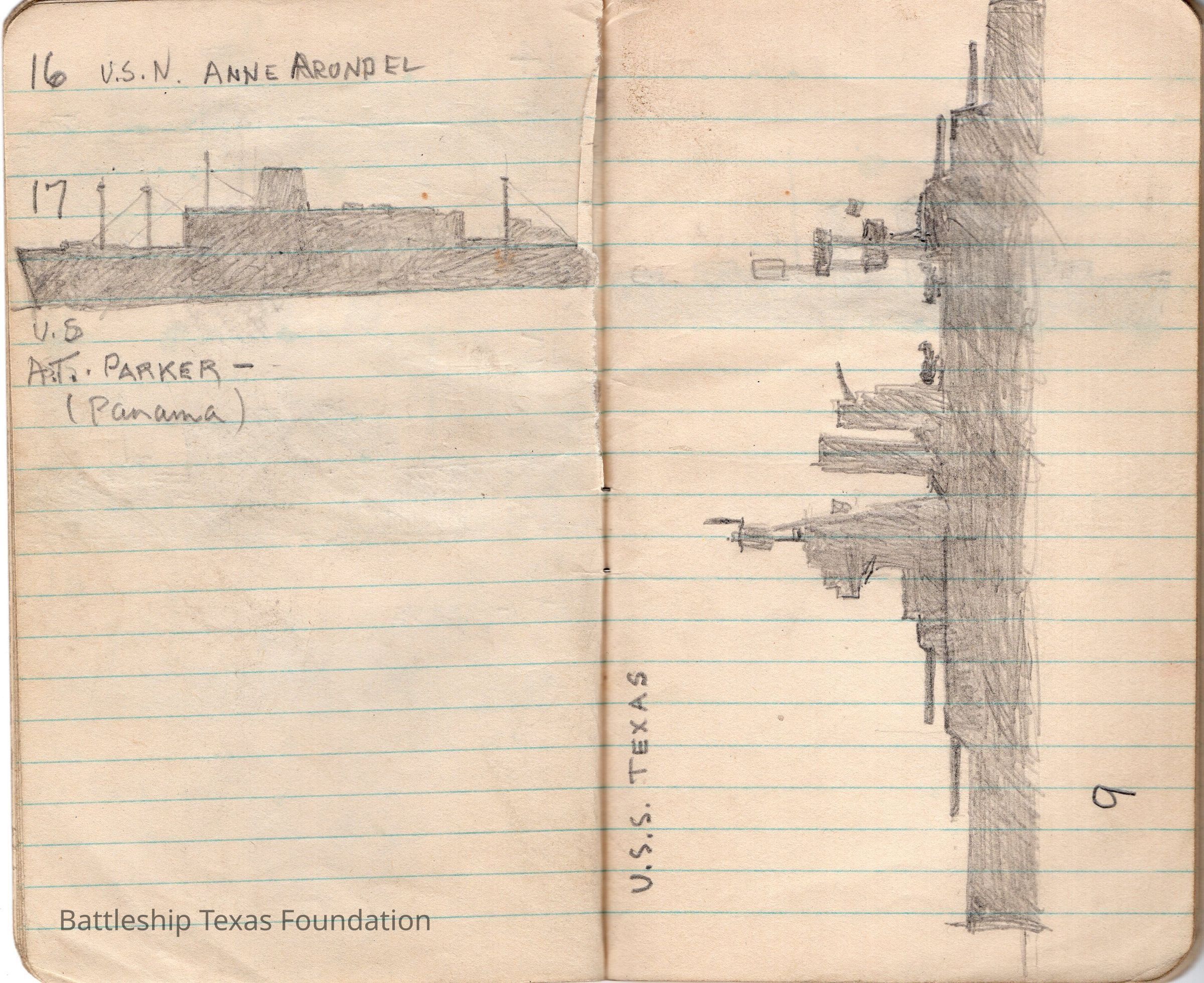
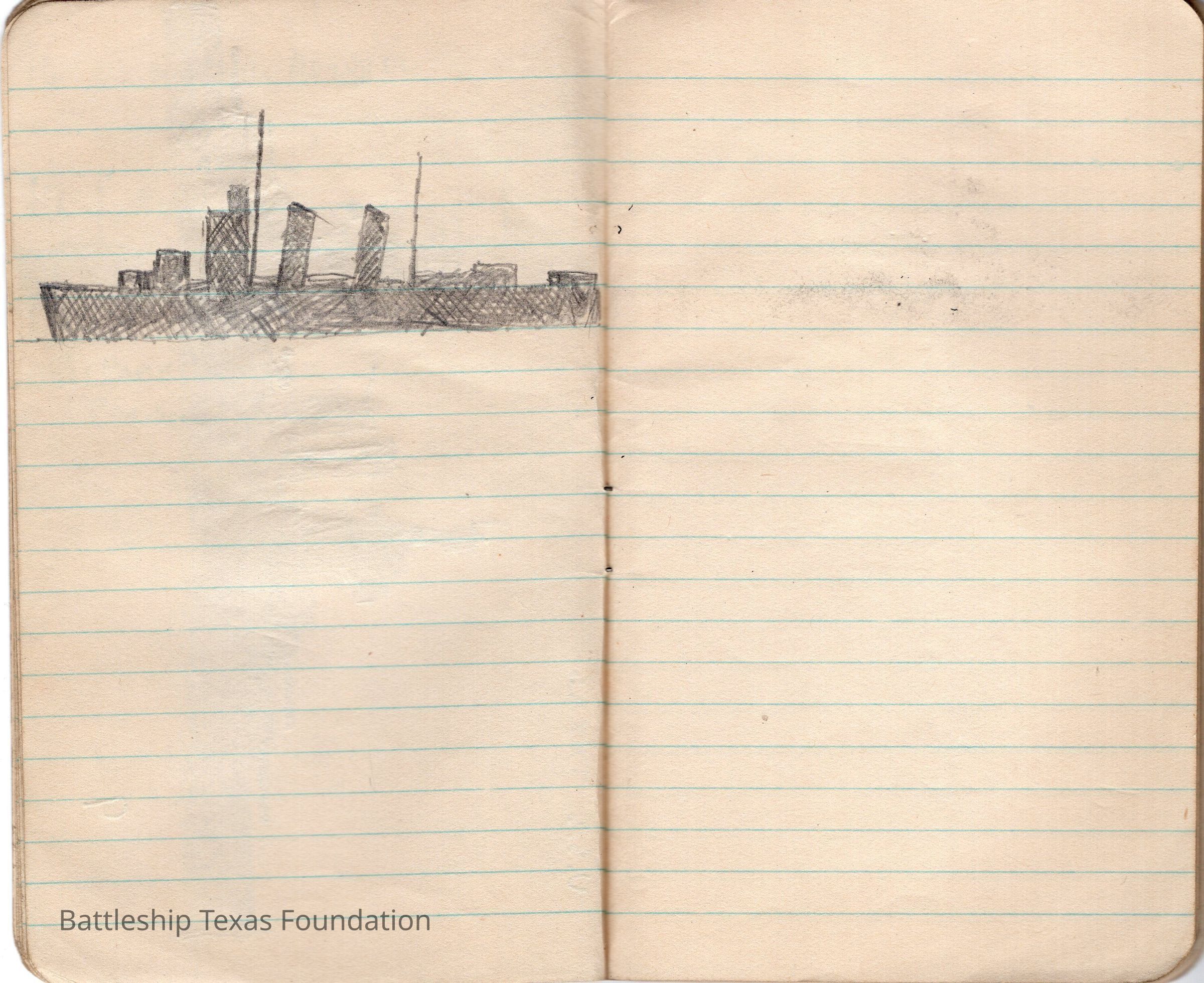
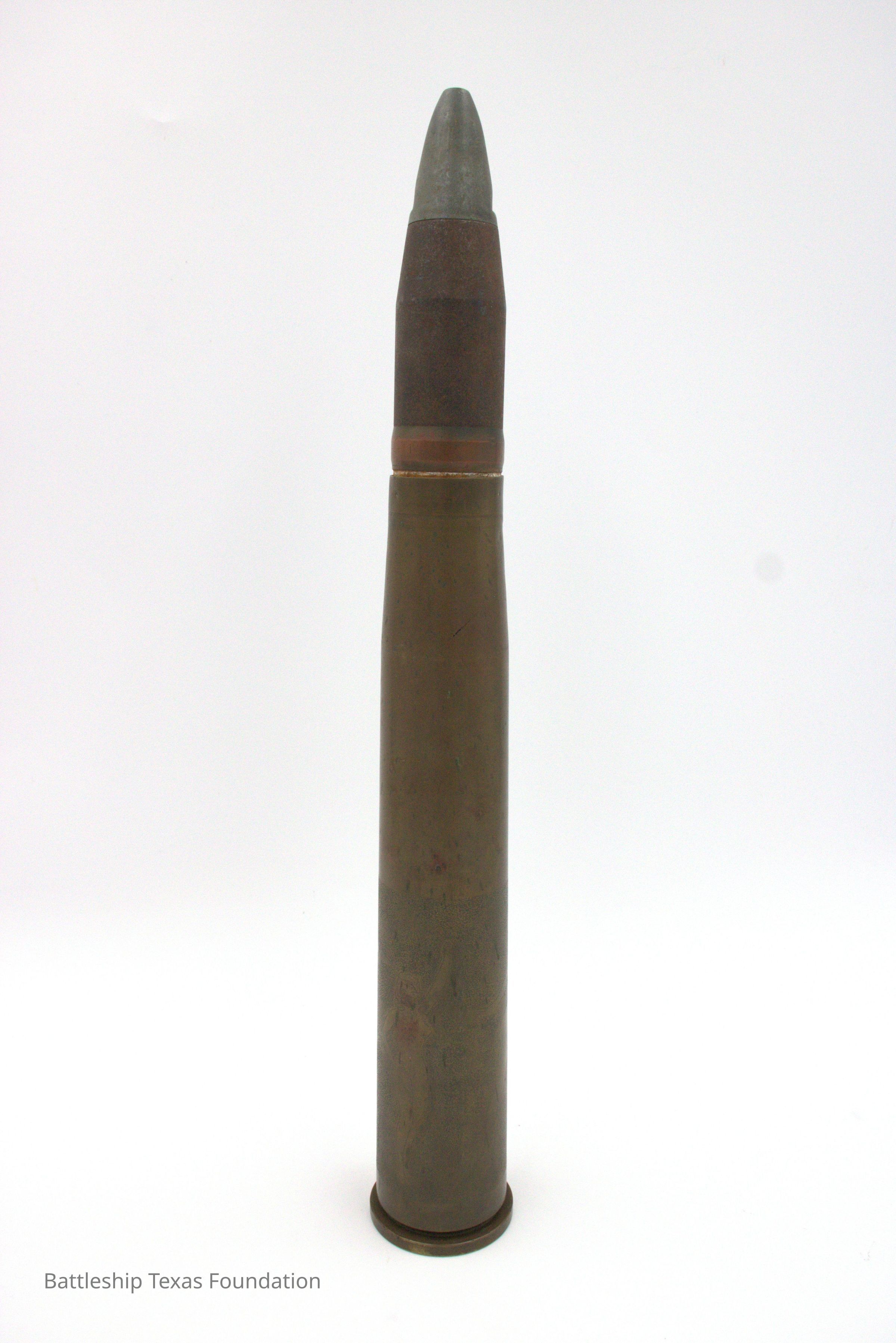
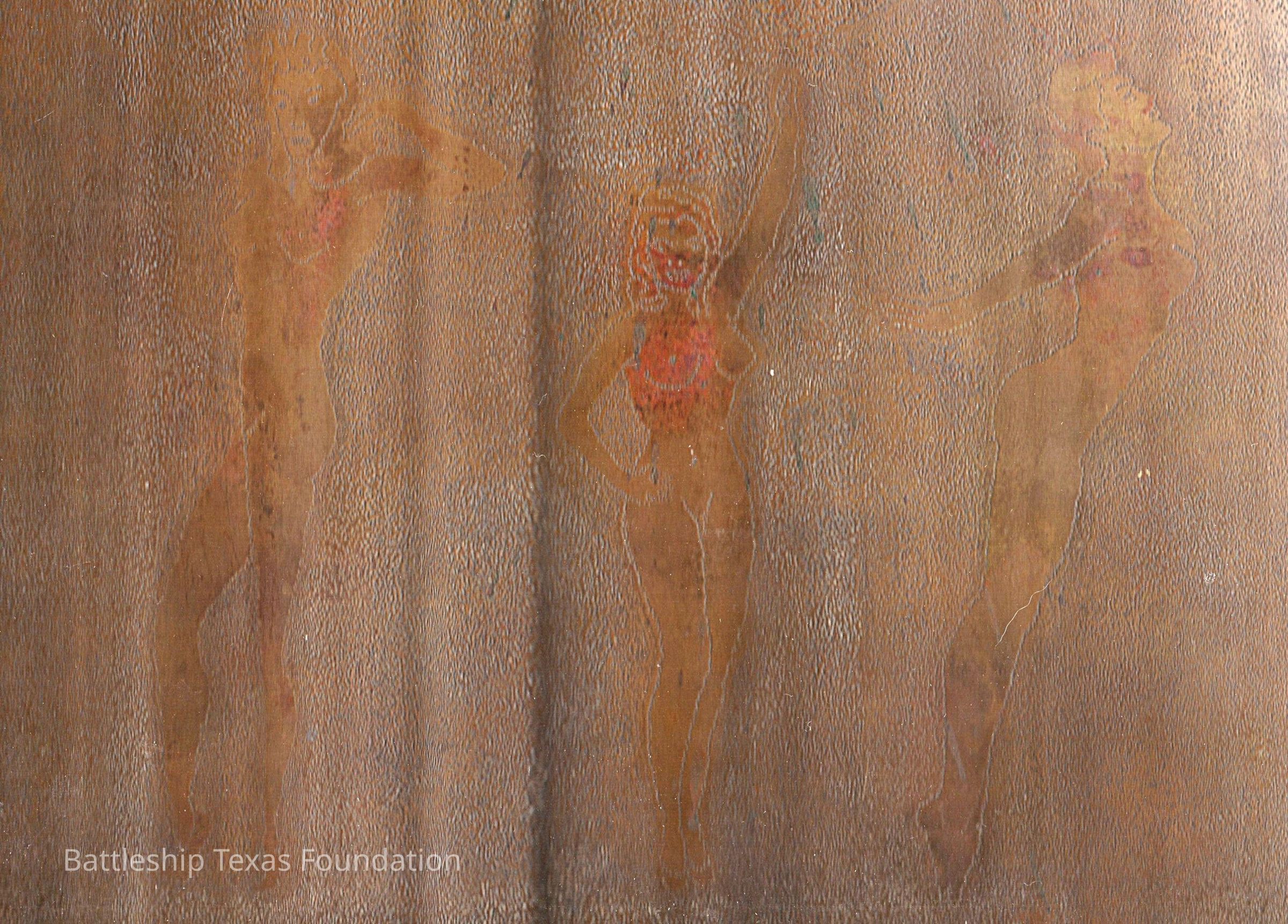
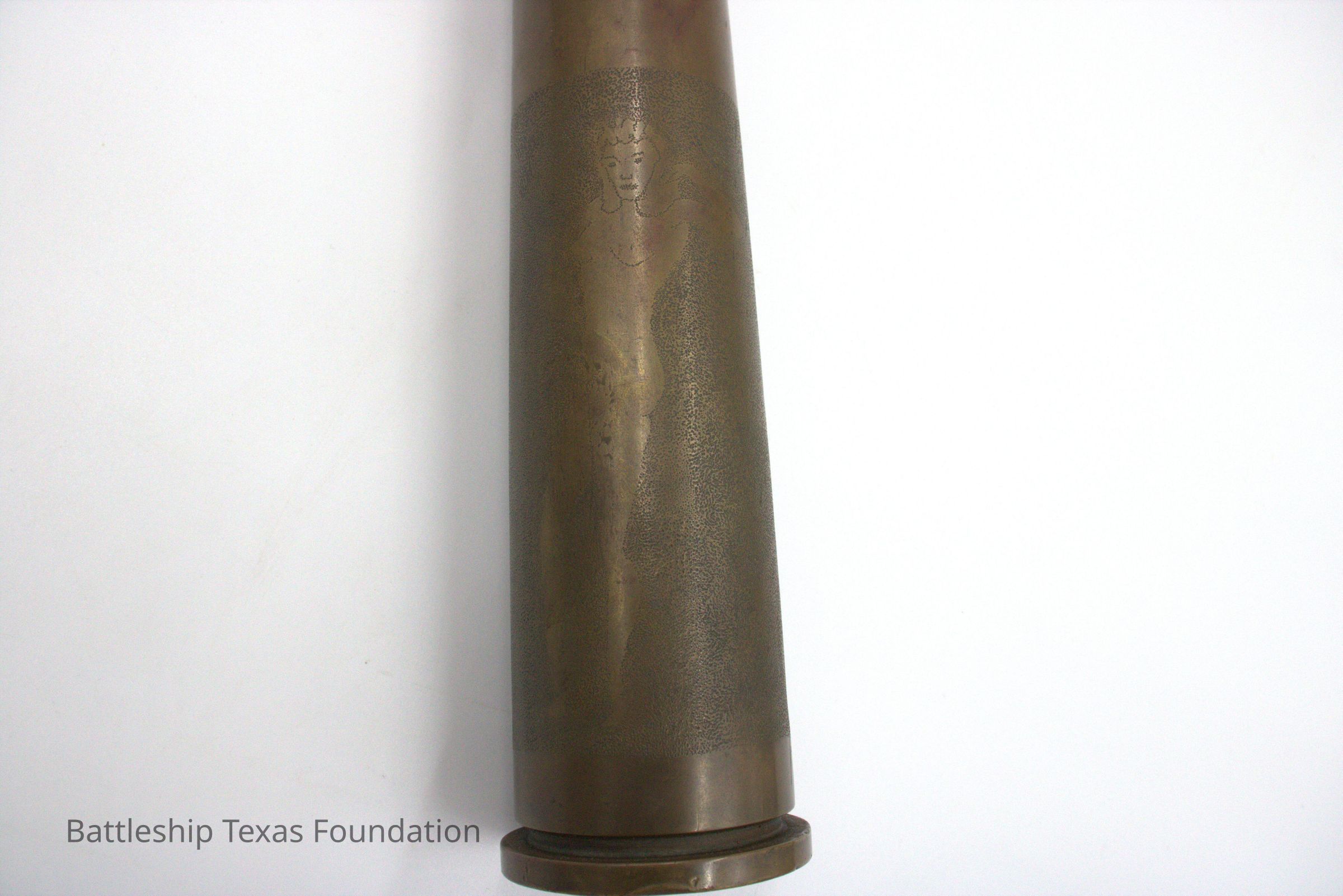
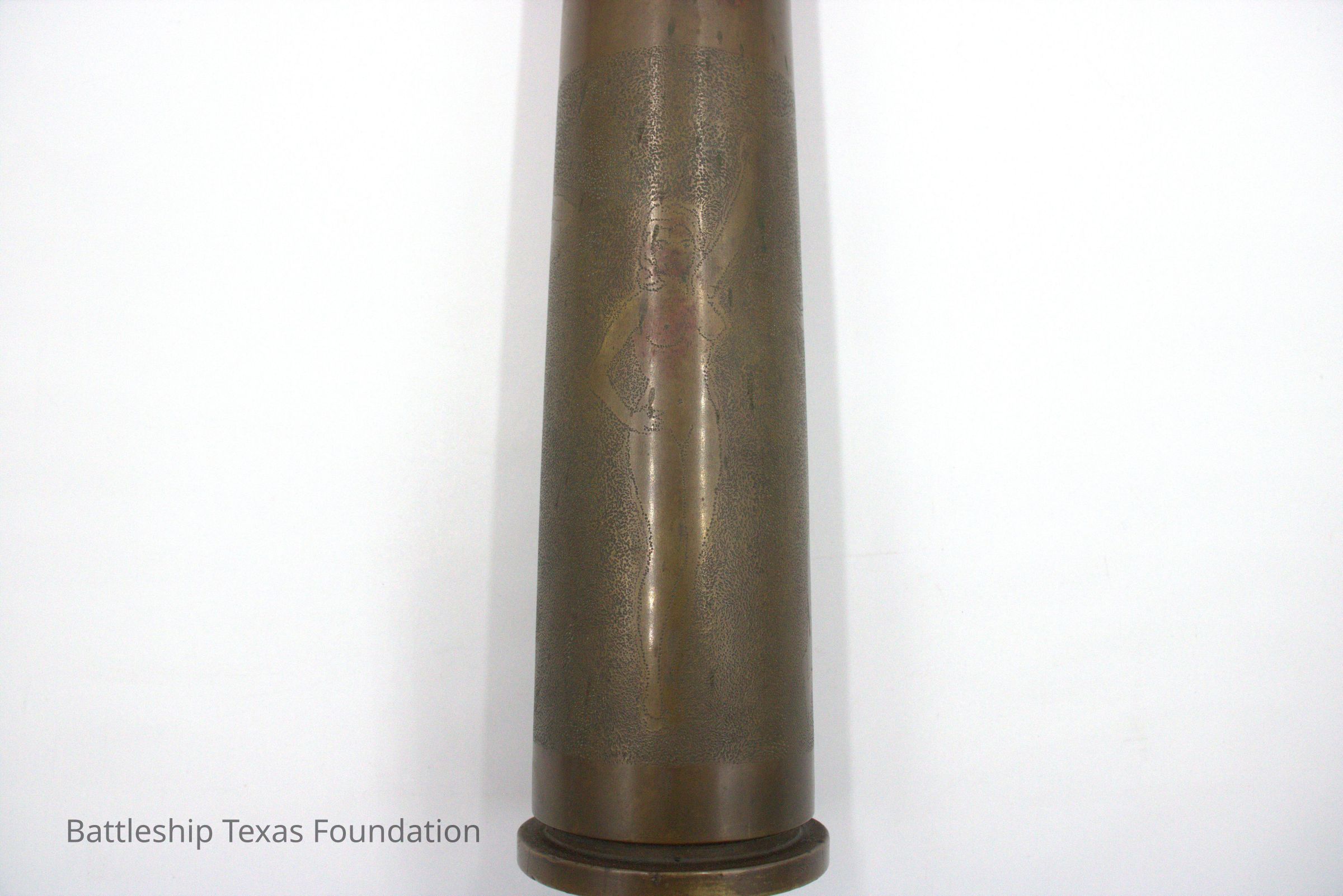
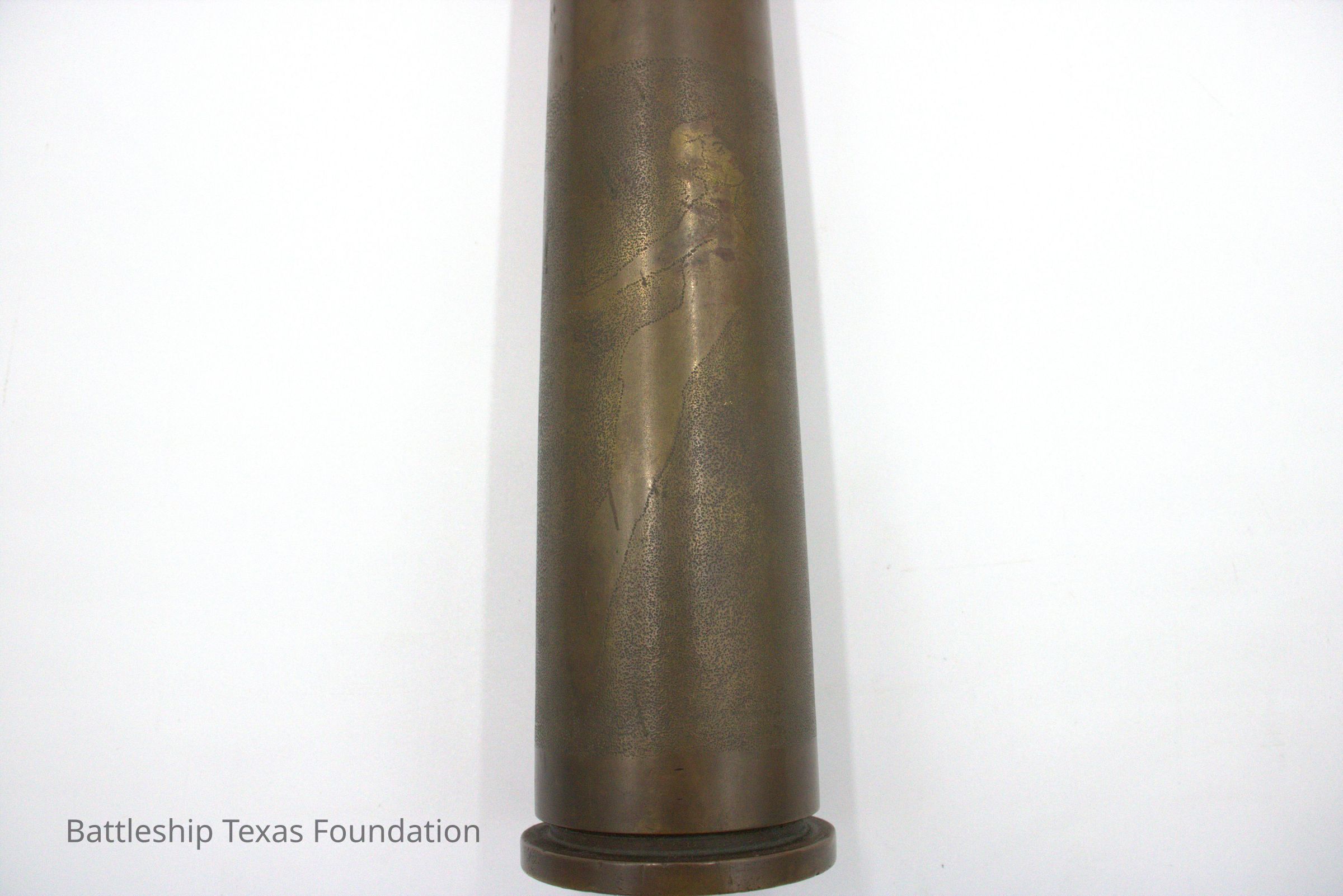
After the United States joined World War II, artistry on Battleship Texas faced a decline. Despite very few examples of crew member art from World War II in collection, Texas often became the subject of art by others in the fleet as they sailed alongside her. In 1943, Alton E. Horton’s troop transport was under the escort of Battleship Texas. When in port, Horton made meticulous effort to record the ships in the convoy with only a pencil and paper. These sketches acted much like a camera, allowing Horton to put to page the view he had before him without the use of an aperture. The second piece of WWII artwork is an etching of three women around the base of a 40mm shell. Trench art was a common mode utilizing discarded shell casings. Servicemembers shaped the brass into lamps, jewelry, ashtrays, and like in this instance, a canvas. The three nude women rotating the base of the shell are in line with trends throughout both World Wars. The nude form, while not the most popular visage, nonetheless saw widespread depiction. This piece of art was not done by a crew member; however, similar methods saw application in art donated to the Texas Parks and Wildlife Department.
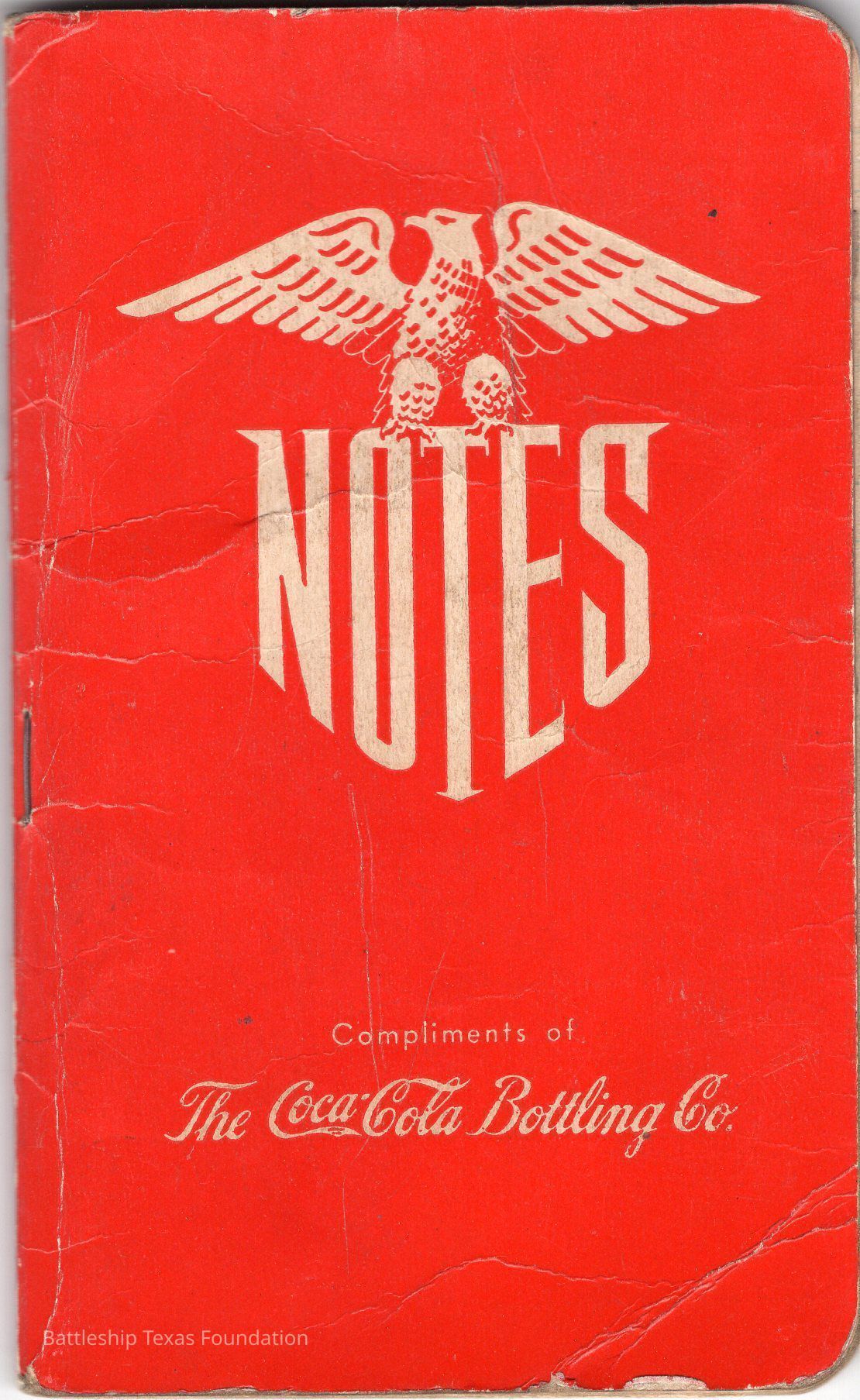
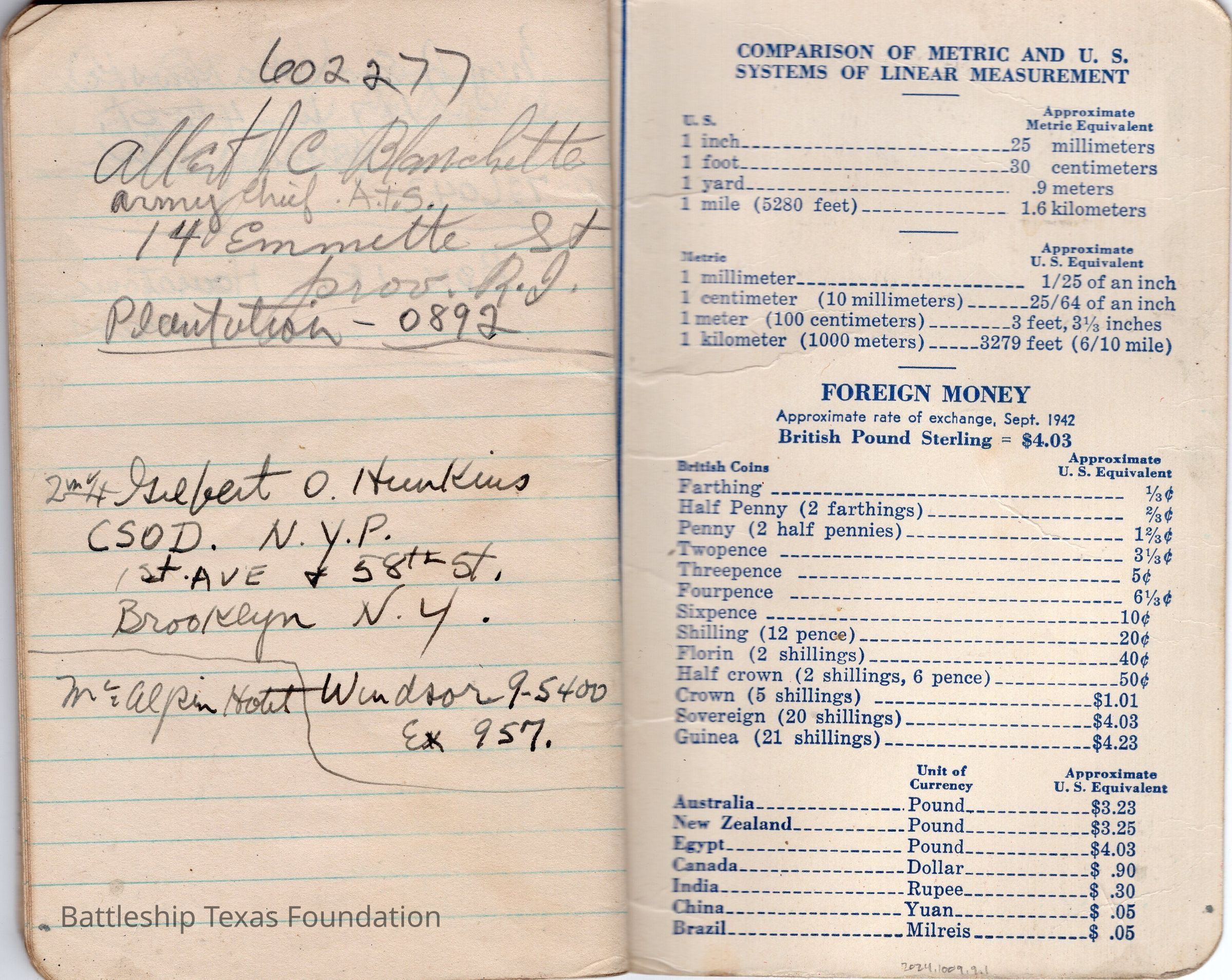
1943 fleet notebook
Description
Notebook drawings by Major Alton E. Horton of the fleet Texas was a part of in 1943. Red cover with eagle perched on "NOTES" title. Bottom of the cover notes the book a product of the Coca-Cola Bottling Company. Notable ships included in the fleet drawings are USS Texas on page 9 and USS Santee (CVE-29) on page 6.
Context
Battleship Texas largely escorted Allied ships across the Atlantic from January 1943 to April 22, 1944. She mainly sailed from New York to either the UK, Gibraltar, or Casablanca. Alton E. Horton was a soldier on a troop transport which was under escort of Battleship Texas in 1943. During his time at sea, he sketched many silhouettes of ships in the fleet. USS Santee (CVE-29) was originally commissioned (AO-29) as a Cimarron-class fleet oiler from October 18, 1940, to Spring 1942. She was converted and recommissioned as a Sangamon-class escort carrier from August 24, 1942, to October 21, 1946. She was sold for scrap to West Germany on December 5, 1959.
40mm trench art
Description
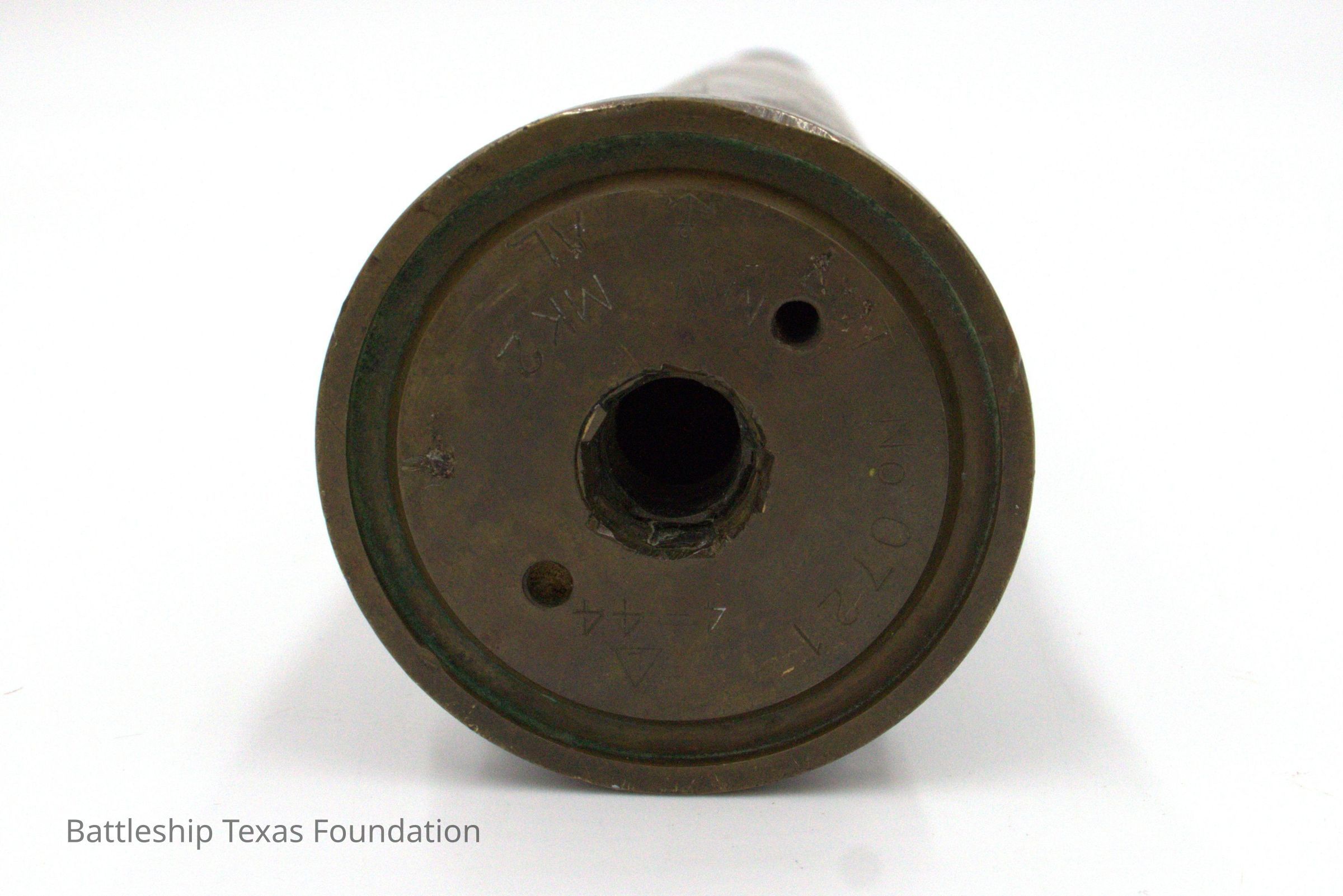
1944 manufactured 40mm bofor shell with projectile still attached. Primer removed and casing empty. Relief etching of three women is on the bottom half of the casing. Artist unknown.
Context
Servicemembers made sculptures most commonly from discarded ammunition shells of various calibers. The practice became popular during World War One and continued into World War Two. Shells could be reshaped, carved, etched, and soldered into myriad decorative objects. By the end of World War Two, Battleship Texas had forty 40mm Bofors. While this piece of art was not done on Texas, art like it was.
The preservation of most of the pieces of art in Battleship Texas Foundation collection is a generally straight forward process. None of the pieces have suffered any serious damage over the last century. Furthermore, while their content differed in each iteration, most are on paper in one form or another. The chief concern is always keeping the paper dry and especially in these cases, dark. Excess light will cause the images on the paper to fade over time, so keeping them secured within archive boxes is paramount to their longevity. Complications arise when viewing the metallic artwork, the vast majority of which in collection is brass. Unlike paper, the oils on the skin can be damaging, and also unlike paper, does not carry the risk of tearing with gloves on. Furthermore, any metallic jewelry could potentially scratch and damage the piece. Both the removal of any jewelry and the use of nitrile gloves is recommended for handling. Even with nickel-plated brass, such as on the swagger stick made by Lawrence J. Gaddis, should be handled with similar caution. The example by Gaddis raises the issue of polish. While his piece is intended to shine, the World War II trench art is unknown, and therefore its stabilization is more important than suspected aesthetics often involved in polishing brass antiques. It is unknown exactly how the artist intended the piece to be viewed and thus should remain stabilized in the state it was in when BTF acquired it.
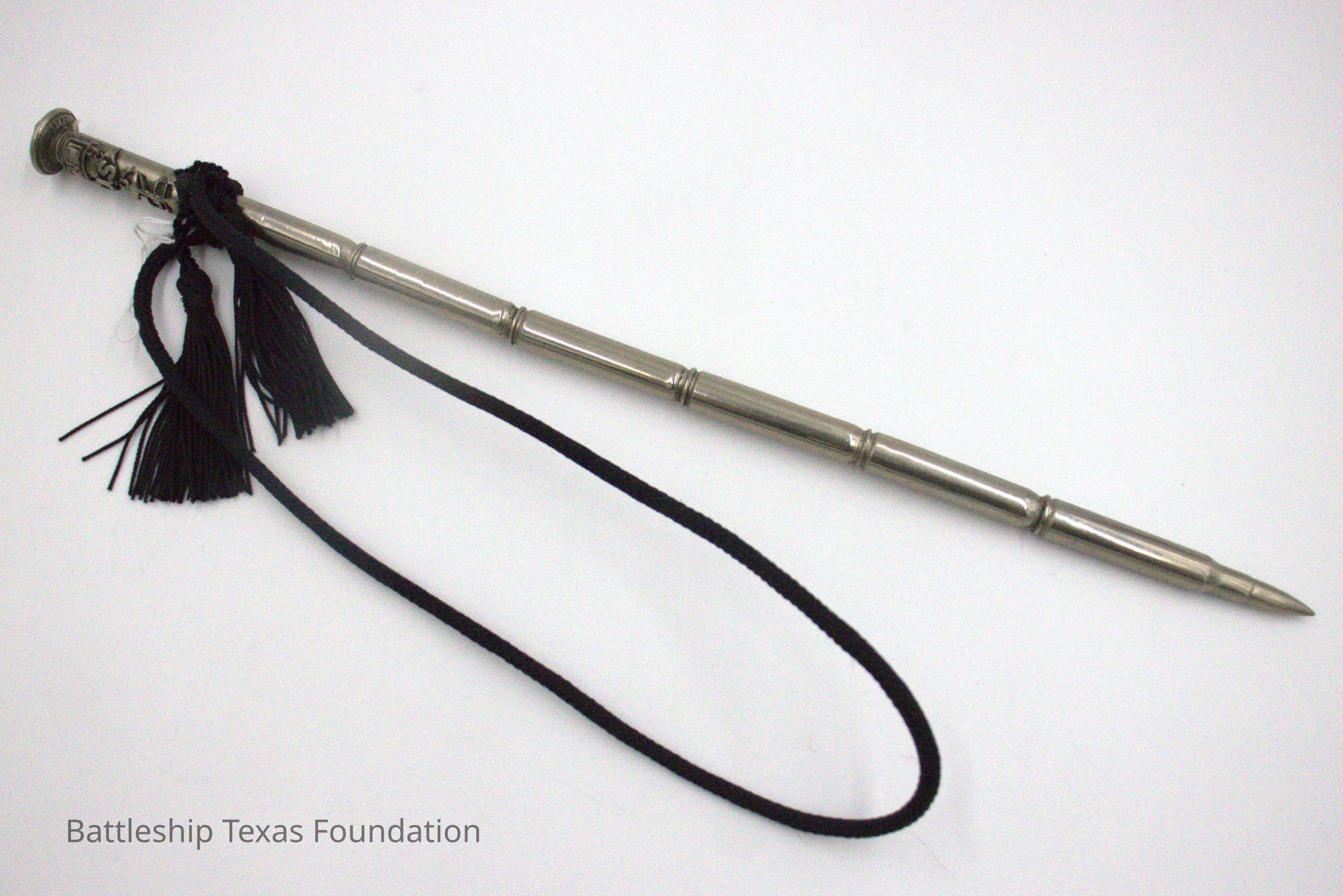
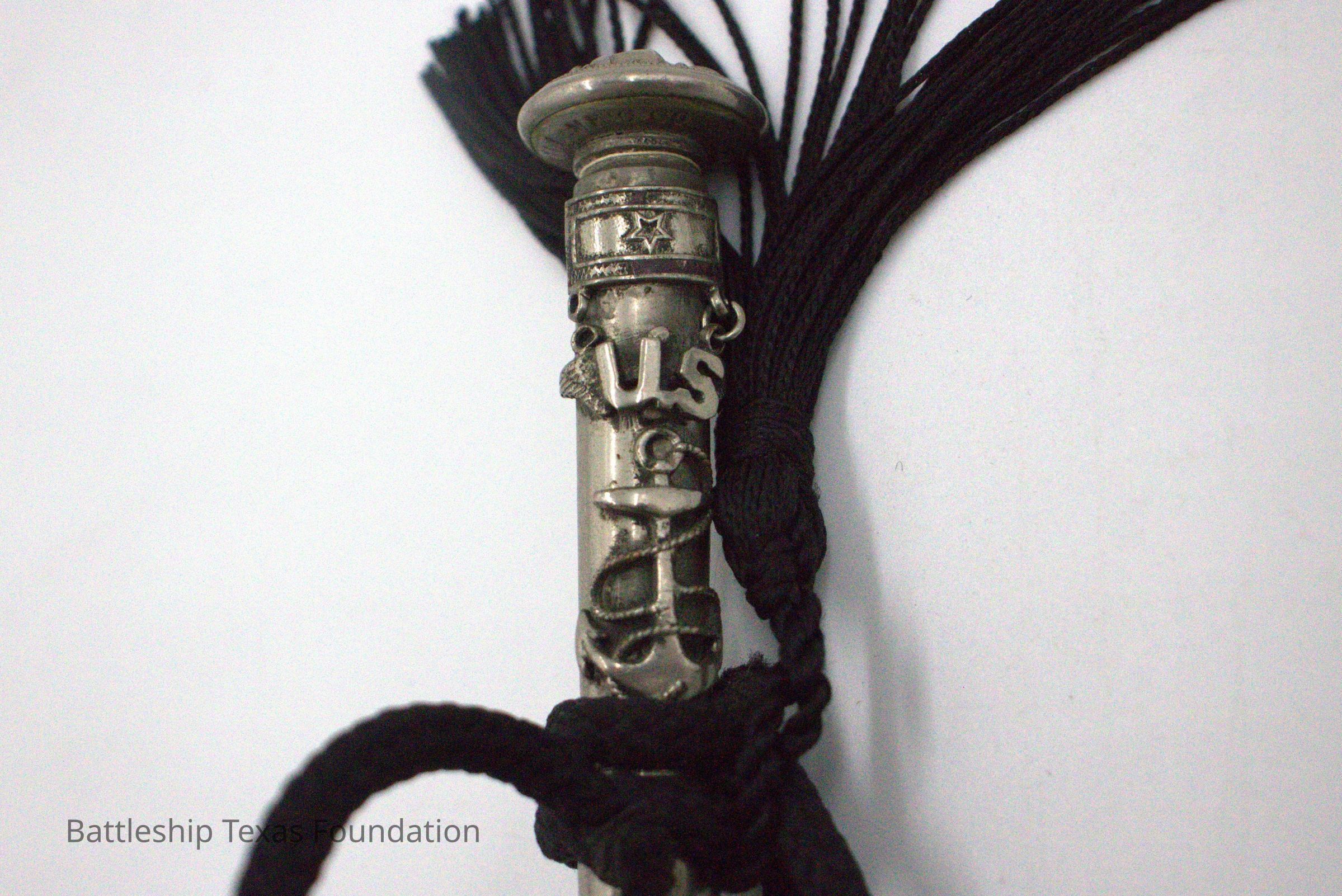
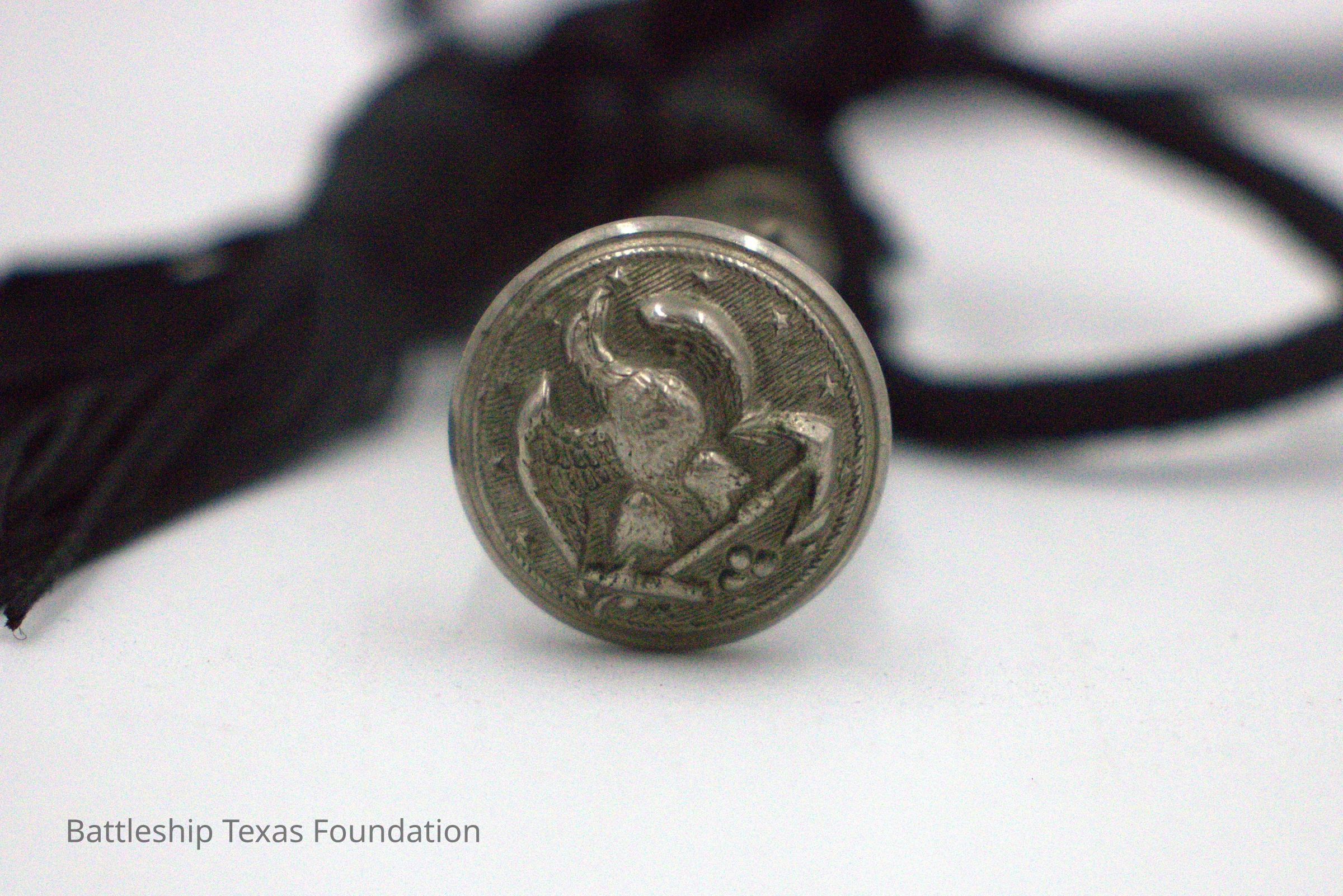
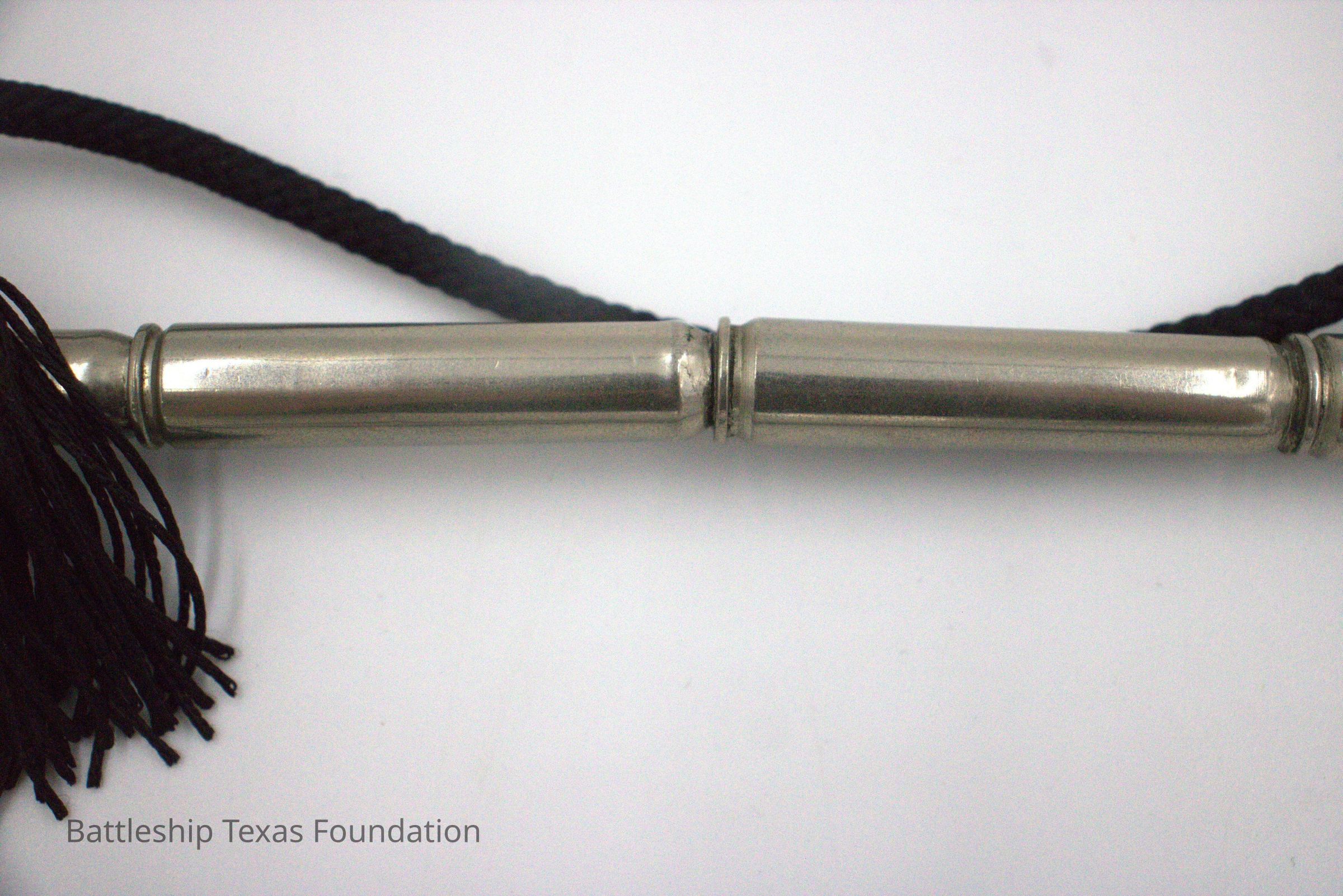
Swagger stick
Description
Custom swagger stick made by Lawrence Gaddis from seven bullet casings soldered together. The caliber of rounds used not present on Battleship Texas and are silver colored, likely from nickel plating. Black rope was tied around the end. Soldering weak between third and fourth bullet from base.
Context
Battleship Texas participated in various fleet maneuvers and exercises in the Atlantic Ocean (1919) and later Pacific Ocean from July 1919 through January 1924. Beginning in February 1923, maneuvers became known as Fleet Problems, which continued to 1939. Lawrence J. Gaddis was a musician on Battleship Texas from 1920 to 1922. He collected many souvenirs and performed on and off the ship during his travels in Pacific waters for Fleet Maneuvers and cruises to South America.
Generous donors give new and interesting artifacts to Battleship Texas Foundation regularly. The art history of Battleship Texas is seldom considered in the grand scope of the ship and her crew’s service. Nevertheless, it remains a crucial element of each individual’s personal expression throughout their time on board. The Battleship Texas Foundation is actively collecting historic items, photographs, and documents related to Battleship Texas (BB-35), Battleship New York (BB-34), or the other commissioned ships named USS Texas (SSN-775, CGN-39, and the first USS Texas commissioned in 1895). If you have an item that makes you say, “It belongs in a museum!” please email us at [email protected] with photos and any relevant information. Our staff is working diligently to collect, accession, and archive historical items of the Last Dreadnought.
James Burke is a History PhD candidate at the University of Houston and has worked as curatorial staff with Battleship Texas since 2020.